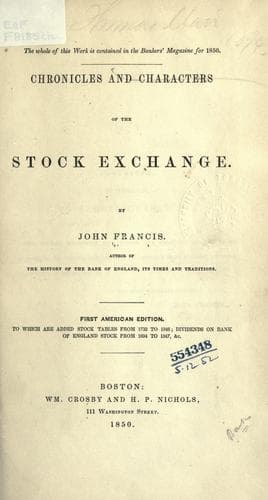
Chronicles and characters of the stock exchangeFrancis, John, of the Bank of England
History
Chronicles and characters of the stock exchange
Francis, John, of the Bank of England
Speculation; Stock Exchange (London, England)
Let us look into the late lotteries; had not a piercing eye detected
the roguery, and not the fall of other things taken off the edge of
the people’s fancy for venturing. These artists have brought up the
tickets to sixteen shillings apiece, advance, even before the act was
passed. That this could not be but by securing the possession of all
the tickets in their own hands, except such select tickets as were
not to come to market, I say this could not be but by connivance,
and this every one knows; and that this connivance again could not
be but by some higher people than those that were named to it, this,
also, every one may know. Who they were, is none of my business
to inquire, though it is easy to guess. It is very hard when our
statesmen come into a confederacy to bite the people, and when dukes
turn stock-jobbers. Yet that this was done is most certain; and what
was this but making a property of the power that might be in their
hands, the better to bite the people? For if the Parliament appointed
£500,000 in tickets, to be given out at a certain rate that was low
and reasonable, was it not to encourage the people, on whom the
rest of the national burden lies? And if, by the craft and knavery
of jobbers, the people are made to pay £600,000 for them, which is
much about the case, pray, why not pay the hundred thousand pounds
to the public, either to pay off a hundred thousand pounds of debt,
or to make the burden of the current year a hundred thousand pounds
lighter?—of which, I am sure, there is need enough.
It has been, indeed, our happiness, that a worthy member, being
informed of this abominable cheat, detected it, and laid it before
the House; upon which a vote was passed to make void all bargains
make for tickets before the act was passed; so the biters were
bitten; and a certain Sir George —— was obliged to refund; but the
roguery of the design was never a jot the less for that.
But the fatal influence of this growing evil does not end here,
and I must trace stock-jobbing now to its new-acquired capacity of
intermeddling with the public, assisting rebellion, encouraging
invasion; and if I do not bring the stock-jobbers, even the Whigs
among them, to be guilty of treason against their king and country,
and that of the worst kind, too, then I do nothing.
Had the stock-jobbers been all Jacobites by profession, or had the
employment led them by the necessity of their business to put king
and nation, and particularly their own, to bargain and sale; and
had the feeling of news been their property, and they had an act
of Parliament, or patent, to entitle them to the sole privilege of
imposing what false things they pleased on the people, I should have
had much the less reason to have complained of their roguery, and
have rather turned myself to the rest of them people, who are the
subject they work upon, and only have stood at Exchange Alley end,
and cried out, “Gentlemen, have a care of your pockets.”
Public-domain text, read in full here on John Shaqi.
Reviews
Reviews
No reviews yet
Be the first to share your thoughts on this work.
Elsewhere in the archive
Join the Discussion
Join the discussion
Sign in to leave a comment or review.
Sign InorCreate an account