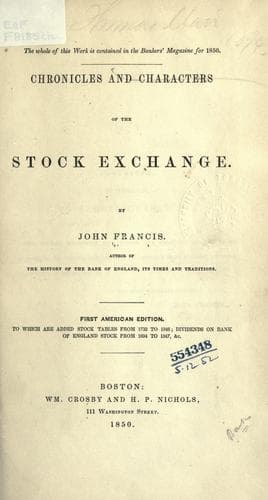
Chronicles and characters of the stock exchangeFrancis, John, of the Bank of England
History
Chronicles and characters of the stock exchange
Francis, John, of the Bank of England
Speculation; Stock Exchange (London, England)
Having thus given the blazing characters of three capital sharpers of
Great Britain, knaves of lesser magnitude can have no room to shine;
the Alley throngs with Jews, jobbers, and brokers; their names are
needless, their characters dirty as their employment: and the best
thing that I can yet find to say of them is, that there happens to
be two honest men among them,—Heavens preserve their integrity; for
the place is a snare, the employment itself fatal to principle, and,
hitherto, the same observation which I think was very aptly made upon
the Mint, will justly turn upon them,—that many an honest man has
gone in to them, but cannot say that I ever knew one come an honest
man out from them.
But to leave them a little, and turn our eyes another way, is it
not surprising to find new faces among these scandalous people, and
persons even too big even for our reproof? Is it possible that stars
of another latitude should appear in our hemisphere? Had it been Sims
or Bowcher, or gamesters of the drawing-rooms or masquerades, there
had been little to be said; or had the groom-porters been transposed
to Garraway’s and Jonathan’s, it had been nothing new; true gamesters
being always ready to turn their hand to any play. But to see
statesmen turn dealers, and men of honor stoop to the chicanery of
jobbing; to see men at the offices in the morning, at the P—— house
about noon, at the cabinet at night, and at Exchange Alley in the
proper intervals, what new phenomena are these? What fatal things may
these shining planets (like the late great light) foretell to the
state and to the public; for when statesmen turn jobbers, the state
may be jobbed.
It may be true that a treasurer or cash-keeper may be trusted with
more money than he is worth, and many times it is so; and if the man
be honest, there may be no harm in it: but when a treasurer plays
for more money than he is worth, they that trust him run a risk of
their money, because, though he may an honest man, he may be undone.
I speak of private, not public treasurers.
Indeed, it requires some apology to say such a one may be an honest
man; it would be hard to call him an honest man, who plays away any
man’s money that is not his own, or more than he is able to pay again
with his own. But if it be dishonest to play it away, that is, lose
it at play, ’tis equally dishonest to play with it, whether it be
lost or no; because, in such a case, he that plays for more than
he can pay, his master runs the hazard more than himself; nay, his
master runs an unequal hazard, for if the money be lost, ’tis the
master’s, if there is gain, ’tis the servant’s.
Stock-jobbing is play; a box and dice may be less dangerous, the
nature of them are alike a hazard; and if they venture at either what
is not their own, the knavery is the same. It is not necessary, any
more than it is safe, to mention the persons I may think of in this
remark; they who are the men will easily understand me.
Public-domain text, read in full here on John Shaqi.
Reviews
Reviews
No reviews yet
Be the first to share your thoughts on this work.
Elsewhere in the archive
Join the Discussion
Join the discussion
Sign in to leave a comment or review.
Sign InorCreate an account