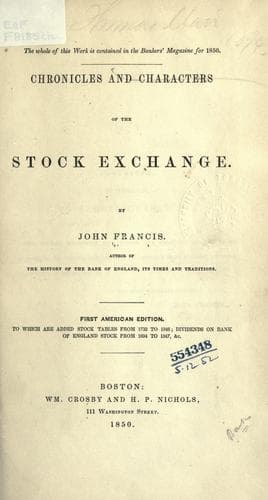
Chronicles and characters of the stock exchangeFrancis, John, of the Bank of England
History
Chronicles and characters of the stock exchange
Francis, John, of the Bank of England
Speculation; Stock Exchange (London, England)
The funds were said to be the nursery of fraud. In the leading
companies the interest of the citizen was sacrificed to the jobber.
The whole town was converted into a corporation of brokers and
usurers, which could lie the government into credit one week and
out of it the next. The magistracy of the city encouraged it, and
the aristocracy of the city pursued it. ’Change Alley was called
a gaming-house publicly set up in the middle of London, towards
which the heads of our merchants and tradesmen were turned instead
of to their legitimate pursuit; and it was said that £80,000 were
paid annually by foreigners in the shape of commissions to the
brokers of the Alley. But it was to the bargains for time that
public attention was principally pointed by the city member. The
origin of these bargains is obvious, and may be traced to the
period of six weeks in each quarter, when the bank books were—as it
was then thought—necessarily closed to prepare for the payment of
the dividend. As no transfer could be made during this period, it
naturally enough became a practice to buy and sell for the opening.
The habit grew by what it fed on; and, in time, periodical dates
for the payment of funds, purchased or sold when it could not be
transferred, were fixed on by the Stock Exchange Committee, at
intervals of about six weeks. As in these transactions the possession
of stock was unnecessary, and the payment of the difference in the
price was sufficient, bargains for time became common, and not only
English, but foreign capitalists, were attracted by the chance of
gain, while the Hebrews flocked to ’Change Alley from every quarter
under heaven.
In consequence of the view which Sir John Barnard took of these
facts, he succeeded in carrying that enactment which, intended to
prevent gambling in the funds, has been utterly and singularly
powerless in its effect. It provided that no loss in bargains for
time should be recoverable in the courts, and placed without the
pale of the law all such speculations. One hundred and sixteen years
have passed, the act is still in force, and speculative bargains
have not only increased, but form the chief business of the Stock
Exchange. The greatest corporation in the world has availed itself
of the principle, and the effect of the statute is, not to prevent
respectable men from speculating, but to make rogues refuse to
pay their losses, knowing that, while the law is inefficient, the
blackboard of the Stock Exchange is their only punishment. To such
men such punishment is ridiculous; they only feel through the purse,
and in that they know they are safe by virtue of an act in which they
rejoice.
Public-domain text, read in full here on John Shaqi.
Reviews
Reviews
No reviews yet
Be the first to share your thoughts on this work.
Join the Discussion
Join the discussion
Sign in to leave a comment or review.
Sign InorCreate an account