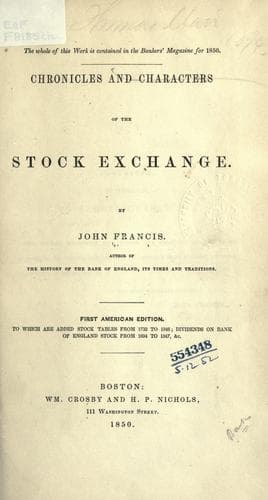
Chronicles and characters of the stock exchangeFrancis, John, of the Bank of England
History
Chronicles and characters of the stock exchange
Francis, John, of the Bank of England
Speculation; Stock Exchange (London, England)
The greatest hit Gideon ever made was when the’ rebel army approached
London; when the king was trembling; when the prime minister was
undetermined, and stocks were sold at any price. Unhesitatingly
he went to Jonathan’s, bought all in the market, advanced every
guinea he possessed, pledged his name and reputation for more, and
held as much as the remainder of the members held together. When
the Pretender retreated, and stocks rose, the Jew experienced the
advantage of his foresight.
Like Guy, and most men whose minds are absorbed in one engrossing
pursuit, Mr. Gideon was no great regarder of the outward man. In a
humorous essay of the period, the author makes his hero say, “Neither
he nor Mr. Sampson Gideon ever regarded dress.” He educated his
children in the Christian faith, but said he was too old himself to
change. Being desirous to know the proficiency of his son in his new
creed, he asked, “Who made him?” and the boy replied, “God.” He then
asked, “Who redeemed him?” to which the fitting response was given.
Not knowing what else to say, he stammered out, “Who—who—who gave you
that hat?” when the boy, with parrot-like precision, replied in the
third person of the Trinity. The story was related with great unction
at the period.
“Gideon is dead,” writes one of his contemporaries, in 1762, “worth
more than the whole land of Canaan. He has left the reversion of all
his milk and honey, after his son and daughter, and their children,
to the Duke of Devonshire, without insisting on the Duke taking his
name, or being circumcised.” That he was a man of liberal views, may
be gathered from his annual donation to the Sons of the Clergy, from
his legacy of £2,000 to the same charity, and of £1,000 to the London
Hospital. He died in the faith of his fathers, leaving £1,000 to the
Jewish synagogue, on condition of being interred in the burying-place
of the chosen people.”
The question of the sinking fund has greatly occupied the attention
of financial men, and upon few schemes have so many and such various
opinions been given. To view the subject by the light of common
sense, it seems palpably absurd that more money than was necessary
should be borrowed for the sake of paying it again, or that, while a
surplus fund remained in the Exchequer, new loans should be raised.
Paine afterwards declared it was like a man with a wooden leg running
after a hare,—the more he ran, the farther he was off.
The first sinking fund is usually called Sir Robert Walpole’s,
because it was adopted by him; but its author was the Earl of
Stanhope. The taxes, which had at first been for limited periods,
being rendered perpetual, proved greater than the charges they were
meant to defray. The surpluses, therefore, were united under the
name of the Sinking Fund, and appropriated for the discharge of the
national debt.
Public-domain text, read in full here on John Shaqi.
Reviews
Reviews
No reviews yet
Be the first to share your thoughts on this work.
Elsewhere in the archive
Join the Discussion
Join the discussion
Sign in to leave a comment or review.
Sign InorCreate an account