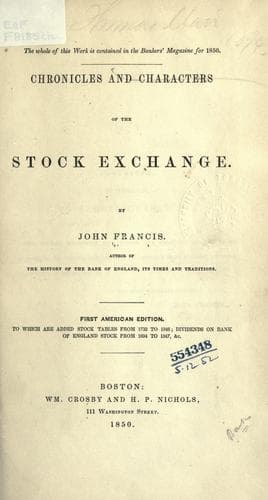
Chronicles and characters of the stock exchangeFrancis, John, of the Bank of England
History
Chronicles and characters of the stock exchange
Francis, John, of the Bank of England
Speculation; Stock Exchange (London, England)
In February, 1674, the jobbers were taken by surprise, and a sudden
fall of fourteen per cent. in India Stock occurred, owing to an
unexpected war in the East. The incident is only remarkable, that
from this period, marked by a fall in their stock to so large an
extent, commenced the political greatness of the Company. A violent
dispute had arisen between Lord Clive and the directors; but their
foreign affairs assumed so serious an aspect, that the latter were
forced to yield. Every vessel brought alarming tidings. The natives,
unable to bear the oppressive exactions to which they were subject,
arose and defied the government. The directors of the Company
grew alarmed. They forgot their feuds, they remembered only their
dividends, and called Clive to their rescue. But Clive refused to act
so long as one Sullivan, his bitter enemy, occupied the position of
chairman; and as the proprietors would have removed the whole court
of directors rather than miss the services of Clive, Sullivan not
only lost his chairmanship, but was within a single vote of losing
his seat as director. During this exciting period, so great was the
bustle, that Cornhill and Cheapside were filled with the carriages of
the voters; and from this dispute, which commenced with so ominous a
fall in their stock, may the territorial dignity of the East India
Company be dated.
Sampson Gideon, the great Jew broker, as he was called in the
city, and the founder of the house of Eardley, as he is known to
genealogists, died in 1762. This name, as the financial friend of
Sir Robert Walpole, the oracle and leader of ’Change Alley, and the
determined opponent of Sir John Barnard, was as familiar to city
circles in the last century as the names of Goldsmid and Rothschild
are to the present. A shrewd, sarcastic man, possessing a rich vein
of humor, the anecdotes preserved of him are, unhappily, few and far
between. “Never grant a life-annuity to an old woman,” he would say;
“they wither, but they never die.” And if the proposed annuitant
coughed with a violent asthmatic cough on approaching the room-door,
Gideon would call out, “Ay, ay, you may cough, but it sha’n’t save
you six months’ purchase!”
In one of his dealings with Mr. Snow, the banker,—immortalized by
Dean Swift,—the latter lent Gideon £20,000. Shortly afterwards,
the “forty-five” broke out; the success of the Pretender seemed
certain; and Mr. Snow, alarmed for his beloved property, addressed a
piteous epistle to the Jew. A run upon his house, a stoppage, and a
bankruptcy, were the least the banker’s imagination pictured; and the
whole concluded with an earnest request for his money. Gideon went
to the bank, procured twenty notes, sent for a phial of hartshorn,
rolled the phial in the notes, and thus grotesquely Mr. Snow received
the money he had lent.
Public-domain text, read in full here on John Shaqi.
Reviews
Reviews
No reviews yet
Be the first to share your thoughts on this work.
Elsewhere in the archive
Join the Discussion
Join the discussion
Sign in to leave a comment or review.
Sign InorCreate an account