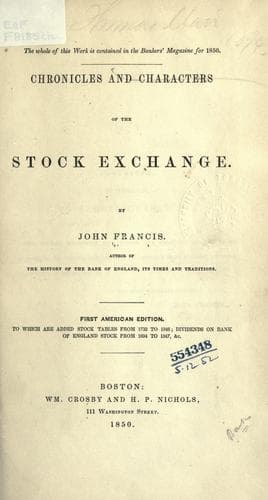
Chronicles and characters of the stock exchangeFrancis, John, of the Bank of England
History
Chronicles and characters of the stock exchange
Francis, John, of the Bank of England
Speculation; Stock Exchange (London, England)
The accession of George III. did not interfere with the conduct of
the war. Nineteen millions were voted the first year of his reign;
and though Mr. Pitt retired from the councils of his Majesty, the
contest was carried on with the same energy; while the system of
subsidies was continued with a profusion which has been rarely
paralleled. Triumphs such as these produced their effects on the
opponents of England. Spain and Portugal were anxious for peace;
France was impoverished, the plate of her monarch converted into
money; and, in 1762, a just and honorable peace was concluded.
It is remarkable, also, that public distress was never less apparent
than during this war; and the rare picture was presented of a people
supporting without murmurs the trials and the taxes of a wide and
costly contest. Prosperity and wealth at home hid the price at which
the victories were purchased abroad. London was never more thriving;
and the importance of several manufacturing districts dates from
the success of the seven years’ war. During this period, the whole
continent of America fell into our power. Twenty-five islands were
captured; twelve great battles won; nine fortified cities, and
forty forts and castles, taken. One hundred ships of war and twelve
millions of specie acquired; sixty millions added to the national
debt, and fifty-two millions raised by taxes.
To produce the peace which followed this contest, bribery was
resorted to, and the public money wasted. “The peace of 1763,”
said John Ross Mackay, private secretary to the Earl of Bute, and
afterwards Treasurer to the Ordnance, “was carried through and
approved by a pecuniary distribution. Nothing else could have
surmounted the difficulty. I was myself the channel through which
the money passed. With my own hand I secured above one hundred and
twenty votes on that vital question. Eighty thousand pounds were set
apart for the purpose. Forty members of the House of Commons received
from me a thousand pounds each. To eighty others I paid five hundred
pounds apiece.”
The continued corruptions produced continued irregularity. George II.
said he was the only master who did not see his servants remunerated;
adding, to Mr. Pelham, that if the civil list were not paid, he would
find another minister. Remonstrances on the injury to the national
and individual interest were so frequent, that the king declared he
would inspect the accounts himself.
The Duke of Newcastle, then prime minister, bowed, and promised
to send the papers; and the following morning, a cart loaded with
official accounts was paraded in the court-yard of the palace. With
much violence, the monarch demanded the cause of the display. “They
form a portion of the accounts your Majesty desired to inspect,” was
the reply; “there is another wagon-full on the road.”
One specimen of the accounts his Majesty had offered to investigate
was, however, quite sufficient; and the public complaint remained
unalleviated.
Public-domain text, read in full here on John Shaqi.
Reviews
Reviews
No reviews yet
Be the first to share your thoughts on this work.
Elsewhere in the archive
Join the Discussion
Join the discussion
Sign in to leave a comment or review.
Sign InorCreate an account