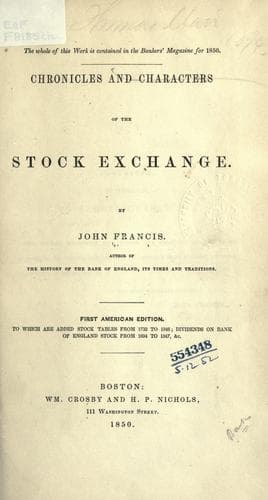
Chronicles and characters of the stock exchangeFrancis, John, of the Bank of England
History
Chronicles and characters of the stock exchange
Francis, John, of the Bank of England
Speculation; Stock Exchange (London, England)
In 1742, £1,384,000 6_s._ 3_d._ was under the sole direction of the
Earl of Orford for secret-service money, of which £50,077 18_s._ went
to the newspapers; and the amount of this supply expended in the six
weeks preceding the resignation of the Earl of Orford was more than
during the three previous years.
In 1766, the House of Commons compelled the East India Company
to rescind a vote which the excitement of the time had induced
them to pass. The success of Lord Clive, the important commercial
consequences to which it led, and the plunder which rewarded the
victories of the soldier, had fired the brains of the East India
proprietary. The most extravagant reports were promulgated, and
half-yearly dividends of fifty per cent. were confidently promised.
The value of the stock rose enormously; and the directors divided at
the rate of thirteen per cent. per annum. When it was found that the
corporation were enabled to divide thus liberally, Parliament, under
the pretence that it might lead to a dangerous panic, interposed
with a strong hand, directed that the annual dividend of the Company
should be limited to ten per cent., and that all accumulations
beyond should accrue to the state. Great opposition was evinced.
The corporation, having paid liberally for their charter, would not
quietly submit to an interference which so materially decreased its
value; and, having formerly bribed with success, tried the same
process, but without the same result. The changes in the opinion of
the “independent” members, as they were bribed by the Company or awed
by the minister, were somewhat curious; and the cause of Charles
Townshend’s tergiversations was probably only a type of many. Having
dealt largely in India Stock, he cried up the Company’s claims to
serve himself. He then sold out at a profit, and cried them down
to serve his friends. It was a complete South-Sea year. A third of
the House of Commons was deeply engaged in the traffic; and jobbing
was the thermometer by which patriots were made or marred. “From
the Alley to the House,” said Walpole, “is like a path of ants.”
Most of the members were in Mr. Townshend’s position, and the East
India Company were, therefore, restricted in their dividends. The
result was, that this corporation is worthy the study of others
in the liberality with which it rewards the labors of its clerks.
Acting on the fine Mosaic principle, that the ox shall not be muzzled
which treadeth out the corn, the Company have made their servants’
interests their own; they have made them understand that their old
age shall be liberally protected if they faithfully serve; they have
made them know that their widows and orphans shall not be forsaken;
and they have, therefore, made them feel that the service of such a
company is a pleasure, and not a pain; a love, and not a labor.
Public-domain text, read in full here on John Shaqi.
Reviews
Reviews
No reviews yet
Be the first to share your thoughts on this work.
Elsewhere in the archive
Join the Discussion
Join the discussion
Sign in to leave a comment or review.
Sign InorCreate an account