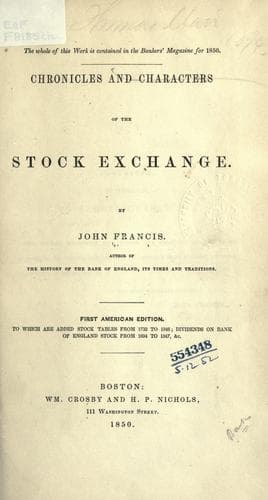
Chronicles and characters of the stock exchangeFrancis, John, of the Bank of England
History
Chronicles and characters of the stock exchange
Francis, John, of the Bank of England
Speculation; Stock Exchange (London, England)
The crisis of 1772 has been entirely overlooked by those who have
bestowed their thoughts upon such subjects. It had its origin in a
variety of circumstances; but the exciting cause was the failure
of the bank of Douglas, Heron, & Co., established in 1769. It was
the period when the success of adventurers in our Indian empire had
contributed to the wealth of England. Immense sums were accumulated
in a few months. Large purchases of land were made at high prices.
All the early and late symptoms of speculation were apparent.
The vast fortunes brought home were ostentatiously displayed. A
contempt for the slow gains of trade, a feverish excitement, and an
ungovernable impatience to be rich, marked the period. The nabobs
were not disposed to hide their wealth under a bushel. They built
magnificent mansions, and mistook ostentation for taste. They raised
the prices of all articles of consumption; they were bowed to before
their faces, and dreaded behind their backs. Dark deeds were told
of them; and the shrewd peasantry shuddered as the massive carriage
rolled by, which held the man whose wealth had been obtained at
the expense of his humanity. The ephemeral literature of the day
is filled with the popular opinion of the character; and the nabob
is commonly represented as a man with a bad liver and black heart.
Scott, with his exquisite conception of the ludicrous, makes one of
his characters define a nabob as “one who comes frae foreign parts,
with mair siller than his pouches can hold: as yellow as oranges, and
maun hae a’ thing his ain gate.”
For thirty years the public was filled with impressions of their
wealth and crimes; and so late as twenty years ago, Lord Clive was
described to the writer as keeping memorials of his guilt in a box
beneath his bed, and as having destroyed himself because his past
enormities were too great for his conscience to bear. The drama, the
story, and the poem, were colored with their eccentricities; while
newspapers occasionally recorded facts which marked that, in some at
least, a fine generosity was mixed with their grossness.
The effect, however, of these things was to make money plentiful; to
raise a spirit of emulation, and a thirst for gold. In addition to
this, the banking-house of Douglas, Heron, & Co. circulated its paper
with a freedom which had an effect upon the population of Scotland
remembered to the present day. Discounts for a time were plentiful.
Bills presented by farmers, and accepted by ploughmen, were readily
cashed. As is usual in these cases, the dashing character attained by
the bank attracted those who should have known better; and many, who
boasted of their foresight, paid for their presumption.
Public-domain text, read in full here on John Shaqi.
Reviews
Reviews
No reviews yet
Be the first to share your thoughts on this work.
Elsewhere in the archive
Join the Discussion
Join the discussion
Sign in to leave a comment or review.
Sign InorCreate an account