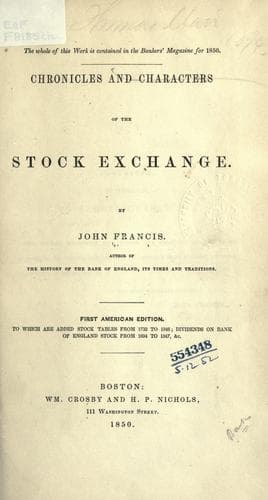
Chronicles and characters of the stock exchangeFrancis, John, of the Bank of England
History
Chronicles and characters of the stock exchange
Francis, John, of the Bank of England
Speculation; Stock Exchange (London, England)
The 16th of May was a memorable period for the country and for the
Stock Exchange. The personal insult offered by the French Consul to
the representative of his Majesty; the evident determination of the
same people to break all ties and truces, rendered an appeal to arms
once more necessary; and on that day the fierce and fatal war which
followed the truce of Amiens,—which desolated the fairest fields of
Europe,—which crushed the ambitious man who provoked it,—and which
added two hundred and sixty-three millions to the national debt,—was
proclaimed.
In 1806, Joseph Elkin Daniels, a conspicuous character in the Alley,
and known for some time as a dealer in securities, availed himself of
the confidence of the members of the Stock Exchange, to perpetrate a
fraud as novel as it was notable. As a dealer in the funds for time,
he was well known; and his frequent transactions, combined with the
trust which his character had achieved, gave his broker a confidence
in his proceedings of which he proved utterly unworthy. The time was
an important one. The Continent was struggling against the iron yoke
of Bonaparte. Austria was making that last great struggle with her
enemy which ended at Austerlitz; rumors were plentiful, and the price
of stock varied greatly, when the man Daniels came to the broker, and
desired him to buy omnium on account. The price was high, but his
request was complied with. Omnium continued to advance, and Daniels
continued to buy, although the price increased from ten to thirteen
premium. When the broker had completed his orders to the amount of
£30,000, he grew anxious for his money, and applied for payment.
Daniels, however, quieted him by saying, he was so sure the price
would rise, that his friends would lend him on the security of the
stock, to enable him to make the most of his speculation, and that
he should, therefore, hold the entire amount. The statement seemed
a fair one. Daniels was believed to be honest, and the broker handed
him £30,000 omnium, for which Daniels gave him his draught on Smith,
Payne, & Smith.
The first part of this man’s fraudulent scheme was now acted. He knew
the check would not be presented until the afternoon, and that he
was, therefore, free from danger for a few hours. He immediately took
the omnium to other brokers, represented to them an urgent necessity
for money, sold it, and having been paid checks for the amount,
immediately presented them to the bankers on whom they were drawn,
and received the amount in cash. He then went to all whom he knew, or
would trust him, borrowed money on the security of his own checks,—a
common practice on the Stock Exchange,—with remarkable boldness,
remained in London until near the hour when he knew his own draught
would be presented and refused, and then left, laden alike with gold
and a guilty conscience.
Public-domain text, read in full here on John Shaqi.
Reviews
Reviews
No reviews yet
Be the first to share your thoughts on this work.
Elsewhere in the archive
Join the Discussion
Join the discussion
Sign in to leave a comment or review.
Sign InorCreate an account