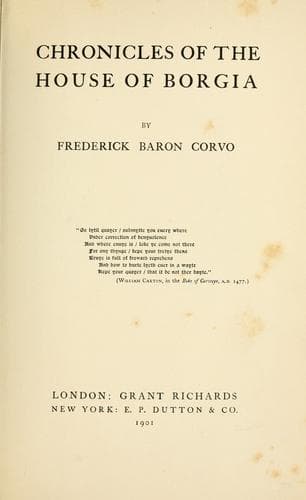
Borgia family; Borja, Francisco de, Saint, 1510-1572; Italy -- History -- 1492-1559
It became evident that Milan must cede to France, the new ally of the
Lord Alexander P.P. VI; and this signified the final rupture of the
alliance of Borgia and Sforza. First, firm friends; next, strong
supporters of the House of Borgia; then, indifferent neutrals; later,
declared traitors; last, negligeable quantities; the conduct of the
House of Sforza was influenced by one idea—loyalty to their name. It was
the head of the House who was responsible, Duke Ludovico Maria
Sforza-Visconti, a coward, a scoundrel, a traitor, a murderer in
intention, the wretch who brought invading Frenchmen into Italy to aid
his usurpation of the throne of Milan—to him be all the blame. The
Vicechancellor-Cardinal Ascanio Maria Sforza-Visconti and all the Sforza
of Pesaro, Santafiora, Chotignuola, Imola and Forli, followed the head
of their House; and, as he led them astray, so he must be decried.
Sforza has produced cardinals a many; but never a Pope. Sforza was never
nearer to the pontificate than in this reign. Ascanio was more than
likely to succeed the Lord Alexander—far more likely than the diabolical
plebeian who did succeed. But Sforza followed the head of its House;
committing political suicide. Loyalty in any age is rare: under all
circumstances it is heroic, admirable.
From the Catholic King and Queen of Spain, Don Hernando and Doña
Isabella, came the sometime pontifical captain Don Gonsalvo de Cordoba,
charged to scold the Holiness of the Pope because of His new alliance
with France. A very old weapon again was refurbished, and Catholic
Spain, in fear or envy, menaced a Spanish Pontiff, Who had given her the
New World, with Cardinal Giuliano della Rovere’s stupid General Council.
So, in the shuffling of the cards, misery made strange bed-fellows
acquainted.
Then the Orient blazed with sudden war, and the Muslim Infidel began
hostilities with Venice. Christendom had lost Lepanto[39]; the Turks
were intoxicated with success; and in Rome the Lord Alexander was deep
in the scheme of a new Crusade when the year 1498 died.
* * * * *
Public-domain text, read in full here on John Shaqi.
Reviews
Reviews
No reviews yet
Be the first to share your thoughts on this work.
Elsewhere in the archive
Join the Discussion
Join the discussion
Sign in to leave a comment or review.
Sign InorCreate an account