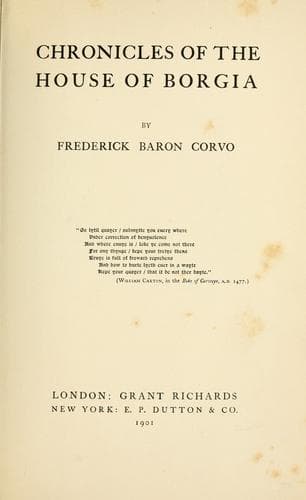
Borgia family; Borja, Francisco de, Saint, 1510-1572; Italy -- History -- 1492-1559
The year 1499, being the penultimate year of the Fifteenth Century, was
occupied as far as the City was concerned with preparations for the
Jubilee; that curious ceremony wherewith the Church affords an
opportunity to the faithful to cleanse their souls from stain of sin by
penitence and pious works. Penitence is an affair entirely personal, to
be entreated of between a sinner and his Judge: but the Church, who
(according to the Thirty Nine Articles) “hath power to ordain its rites
and ceremonies,” prescribes the ceremonial works to be performed. In
brief, these works consist in certain visits to certain basilicas of
Rome, which must be entered by certain doors, and where certain prayers
must be prayed. The Church, being a system, is systematic. In return for
these works always supposing them to be accompanied by the appropriate
penitence, She promises, from the infinite treasury of the Merits of our
Divine Redeemer remission of the canonical punishment incurred, during
his past life, by the sinner now penitent and purposing amendment. This
Complaisance on the part of the Church technically is called an
Indulgence; and the Jubilee Indulgence is in high esteem and eager
acceptation. It is not in any sense a licence to sin; as, by a
singularly silly misconception of its name,[42] it has been supposed to
be: but, absolutely, a formal wiping of the slate, a ceremonial enabling
of the soul to start anew. The Jubilee begins on Christmas Day with the
opening, by the Supreme Pontiff, of a certain door in the Vatican
Basilica, which remains an ingress until the Christmas Day of the
century-end; and vast pilgrimages are used to flock into the City at
such times. The year 1499 saw erected accommodation for visitors in the
Borgo Nuovo, and numerous improvements on the Vatican side of Tiber.
Churches were restored and furbished, the Mola of Hadrian strengthened;
and the new wing of the Apostolic Palace of the Vatican called the
Borgia Tower, which the Lord Alexander P.P. VI had built, was decorated
in fresco by the brush of Messer Bernardino Betti (detto Il
Pinturicchio).
In his book on the lives of artists which Giovanni Vasari wrote half a
century later it is said that Il Pinturicchio painted on a wall of the
Borgia Tower a picture of the Blessed Virgin Mary before whom the Borgia
Pontiff kneels in adoration. Vasari also says that the painter used, as
his model for Deipara, Madonna Giulia Orsini (nate Farnese) who was the
Pope’s mistress: and this statement is repeated by many, to this day,
including the German historian Herr Gregorovius (who pretends to have
been guided by documents and by documents alone), as an example of the
flagitious profligacy and profanity of the Lord Alexander P.P. VI.
Public-domain text, read in full here on John Shaqi.
Reviews
Reviews
No reviews yet
Be the first to share your thoughts on this work.
Elsewhere in the archive
Join the Discussion
Join the discussion
Sign in to leave a comment or review.
Sign InorCreate an account