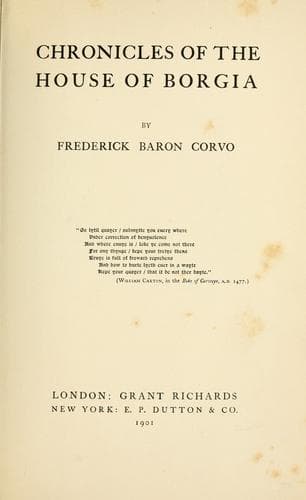
Borgia family; Borja, Francisco de, Saint, 1510-1572; Italy -- History -- 1492-1559
The Lord Alexander P.P. VI read the _Letter to Silvio Savelli_. It is
recorded that His Holiness deigned heartily to laugh with His courtiers
over the exaggerated absurdity of the satire. As for its coarseness—the
Romans always value _simplicitas_ and _urbanitas_ of speech, _i.e._,
hideous grossness and brutal jest. As for taking offence—well, Consul
Caius Julius Caesar laughed at the crabbed little couplet of Caius
Valerius Catullus, and invited him to supper; and the Lord Alexander
P.P. VI had lived too many years in Italy not to have taken the correct
measure of Milanese, Florentines, Venetians, Neapolitans; and He was
well able to apportion its just value to extravagance of praise or to
extravagance of blame. With His magnificent dignity of temper, He said
that in Rome there was liberty of speech: and that He cared nothing for
libels against Himself. (Costabili to Duke of Ferrara, 1 Feb. 1502).
They amused Him, if they were witty; they pleased Him, if their language
shewed distinction: and that was all.
Duke Cesare de Valentinois was not of so gracious a humour. Towards the
end of November after the publication of the _Letter to Silvio Savelli_,
a certain Messer Girolamo Manciani, a Neapolitan, was taken in the
Region of Borgo on a charge of publishing calumnious epigrams against
the Duke which proved him to be the author of the famous _Letter_. His
right hand and tongue were promptly cut off and out. Two other defamers
employed by the Aragonese Dynasty (as Pontano had been, and Sannazar
“the Christian Vergil” was) to flout the Borgia underwent a similar
mutilation; and when the Orator of Ferrara spoke of them to the Pope, it
is said that He answered, “What can We do? The Duke means well; but he
does not know how to bear insults. We often have advised him to follow
Our ensample, and to let the mob say what it will: but he answered Us
with choler that he intended to give those scribblers a lesson in good
manners.” The good heart of the Pope spoke there. The Duke was only
carrying out the law by this severity; laws, which it would ill-become
the Lawgiver to set aside. Still, the offence being against the person
of that Lawgiver, it was open to Him privately to recommend leniency:
and that He did. No man could do more.
* * * * *
Public-domain text, read in full here on John Shaqi.
Reviews
Reviews
No reviews yet
Be the first to share your thoughts on this work.
Elsewhere in the archive
Join the Discussion
Join the discussion
Sign in to leave a comment or review.
Sign InorCreate an account