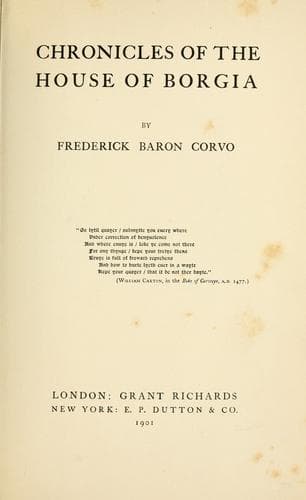
Borgia family; Borja, Francisco de, Saint, 1510-1572; Italy -- History -- 1492-1559
(π) The herb Violet (_Viola odorata_), made into an unguent with lard
or honey, cures wounds.
(ρ) The herb Wildgourd (_Cucumis colocynthus_, κολοκύνθος ἀγρía), its
inward neshness pounded in lithe beer without the churnels, will
stir the inward.
Those are Simples, _i.e._, medicaments derived from single herbs, easily
come-by, within the reach of all; suited to a simple, but by no means
silly, race of men content with simple things, gifted with faith and
sense, and unconcerned to dive below the surface and explore, or
experiment with, nature’s sacrosanct arcana.
* * * * *
The Renascence of Learning, when the works of ancient writers were
rediscovered, devoured, put in practice, filled men’s minds with new
ideas, and completely changed their point of view.
_The Most Salubrious Precepts of Medicine_ written by Quintus Serenus
Sermonicus in the Third Century; the Thirty Seven Books of _Natural
History_ by C. Plinius Secundus (Pliny Senior) which first saw light in
A.D. 77; the eighty-three _Treatises_ of Claudius Galenus, (A.D.
130–200); the thirty-four chapters of the _Animal Medicaments_ which
Sextus Placitus wrote in the Fourth Century after the Incarnation; the
eight books of Alexandros of Tralles in Lydia, _On Medicine_, first
given to the world in the Sixth Century;—these were the keys that opened
the door of speculation to the alert and eager men of the Fifteenth
Century, already intoxicated by the glorious Discovery of Man.
Weird and wonderful effects were produced by this flood of knowledge.
Weird and wonderful were the new significances given to natural things,
the combinations of natural objects projected, the doctrines evolved
from observation of natural phenomena. The study of nature became a
sacred thing, reserved for the reverent and wise. Its followers were
called magi, or magicians; their pursuit was magic. The magical art was
either white or black, for the good or ill of men. Great and holy
personages practised white magic: the black was damned by the Church,
and the bare suspicion of its practice sufficed to burn. The Lord
Alexander P.P. VI distinguished Himself by His severity to the black
magi. White magic included the art of healing; divination by
cheiromancy, amniomancy, lithomancy, astrology, and also experimented to
find out the hidden properties and virtues of all things strange, as
well as common. It was a vast field for research; and the men who walked
therein were just like boys, eager, sensible, ardent, inexperienced,
ready to assume and take for granted.
Public-domain text, read in full here on John Shaqi.
Reviews
Reviews
No reviews yet
Be the first to share your thoughts on this work.
Elsewhere in the archive
Join the Discussion
Join the discussion
Sign in to leave a comment or review.
Sign InorCreate an account