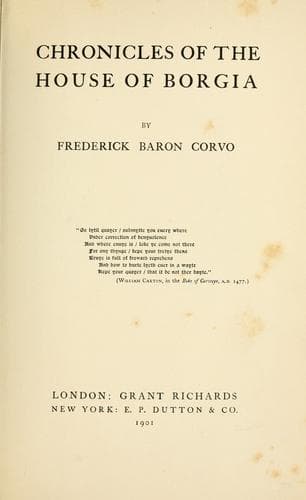
Borgia family; Borja, Francisco de, Saint, 1510-1572; Italy -- History -- 1492-1559
But the chief of the men of science of the Borgian Era was Messer
Giambattista della Porta of Naples. Born in 1445, dying in 1515, he was
an exact contemporary of Borgia. What he did not know of natural
science, no other man of his epoch knew. His house in Naples was a
resort of literary and scientific men of every nation. He established
public and private academies of science in all directions, the chief of
which were Gli Ozioni of Naples and one called Il Secreti which met in
his own house, and to which no mage was admitted unless he had made some
new and notable discovery of natural phenomena. This was the academy
whose name and air of mystery excited intense ecclesiastical suspicion
at Rome, which by hinting at black magic procured the order to close the
meetings of the mages.
Messer Giambattista della Porta was a copious writer. He gave to the
world a treatise On Physiognomy, in which he judges men’s characters by
comparing their faces to those of certain beasts; and a diffuse and
learned work on cyphers, De Occultis Literium Notis. His great work,
however, was The Book of Natural Magic. He says that he began it in
1460, when he barely was of the age of fifteen years;—these were the
precocious times when Messer Giovanni de Medici was a Lord Cardinal at
thirteen and Prince Gioffredo Borgia of Squillace a married man and
captain of condottieri at fourteen;—and thirty-five years later in 1495,
by the help of that lusty young Maecenas the Lord Cardinal Prince
Ippolito d’Este, he published the matured work from which the following
recipes are taken.
Very few English people realize the doctrine of Sympathy and Antipathy;
or admit that Attraction and Repulsion are Primary Forces. “I do not
love thee, Doctor Fell, the reason why I cannot tell,” says the
Englishman, and worries to find that reason instead of recognising the
Law. “She is simpatica and he is antipaticissimo,” says an Italian,
stating and admitting a natural law. Messer Giambattista della Porta is
very clear on the point of Antipathy, which he illustrates by saying
that Vine and Colewort are natural enemies, because Colewort cures
drunkenness; that Rue and Hemlock are natural enemies, because Hemlock
heals blisters raised by Rue: as well as on the point of Sympathy which
he illustrates by saying that a wild bull, tethered to a fig-tree, will
become tame and gentle; and a dog, laid to a diseased part of a man’s
body, will absorb the disease.
He says that beasts have knowledge all their own: that ravens use ivy,
eagles use maidenhair, herons use carrots, on their nests as natural
preservatives against enchantments: that cats eat grass, and pigeons
pellitory, for their ailments: that lions with quartan agues eat apes,
that dim-eyed hawks eat sow-thistle, that serpents rejuvenate on fennel,
and that partridges eat leeks to clear their voices.
Public-domain text, read in full here on John Shaqi.
Reviews
Reviews
No reviews yet
Be the first to share your thoughts on this work.
Elsewhere in the archive
Join the Discussion
Join the discussion
Sign in to leave a comment or review.
Sign InorCreate an account