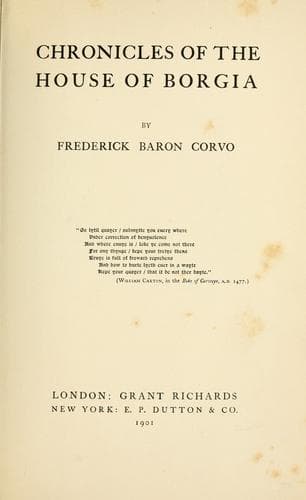
Borgia family; Borja, Francisco de, Saint, 1510-1572; Italy -- History -- 1492-1559
Messer Ramiro d’ Orco, Don Vitellozzo Vitelli, and Don Oliverotto da
Fermo had a legal trial by court-martial, and paid the legal penalty of
crime.
Don Paolo and Duke Francesco Orsini of Gravina suffered merited death,
due to the exigencies of civil war in which they and their House were
the aggressors.
There remain two other violent deaths to be accounted for, which were
not of sufficient importance to treat of in the history of this
pontificate, the case of Calderon Perotto, and that of Messer Francesco
Trocces.
It is said by Don Paolo Capello, the Orator of Venice, in his Diarium,
(or rather in that edition of the said Diarium which was prepared forty
years later by Don Marino Sanuto,) that Calderon Perotto was a Spanish
lad of eighteen years, one of the Pontifical pages; and that he was
stabbed by Duke Cesare (detto Borgia) at the Pope’s feet. The fact is
related without comment or explanation. It would not be safe to attach
much importance to the statement, because Don Paolo Capello’s original
document is not forthcoming and Don Marino Sanuto’s version of what he
wrote is the only version accessible. But the alleged murder of the page
Perotto is not, like other calumnies, a posthumous invention; for it is
mentioned in the atrocious _Letter to Silvio Savelli_ described on an
earlier page. The Pope is not, and was not blamed. The murder, if it
were a murder at all, is attributed to Duke Cesare (detto Borgia); and
it was not an unusual thing for a lord to slay a servant in the Borgian
Era. That was common enough; but to do it in the presence of the
Holiness of the Pope certainly was sacrilege; and this last circumstance
makes it probable that the whole story is a pure invention; for the
guilt of sacrilege lightly was not incurred even by the most bloody and
abandoned villains: and Duke Cesare was not of that species.
Public-domain text, read in full here on John Shaqi.
Reviews
Reviews
No reviews yet
Be the first to share your thoughts on this work.
Elsewhere in the archive
Join the Discussion
Join the discussion
Sign in to leave a comment or review.
Sign InorCreate an account