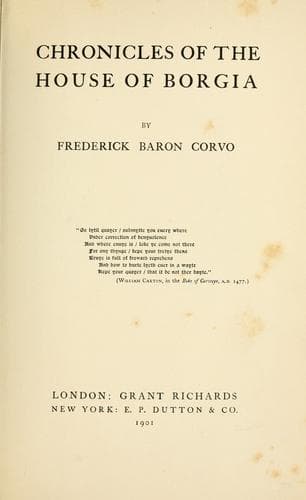
Borgia family; Borja, Francisco de, Saint, 1510-1572; Italy -- History -- 1492-1559
Other malefactors felt the flail which, like Osiris, He wielded equally
with the crook. Notaries of the Pontifical Briefs debauched by the
undisciplined rule of previous Popes, had become corrupt. In the absence
of restraint they habitually forged briefs nominating to benefices, not
only in Italy, but in all Christian countries. The ambition of German
clergy created the demand. The flagitious notaries managed the supply.
They sold their forged briefs privately to whoso would pay the price,
and they pocketed the proceeds of this nefarious traffic. In 1497, the
Lord Alexander P.P. VI found them out. Some promptly were broiled on
Campo di Fiori, the nineteenth of October; one, the Lord Archbishop of
Cosenza, and three secretaries, deprived of their benefices and degraded
from their clerical estate, solemnly were immured alive in the Mola of
Hadrian. These miserable criminals lived some years in their solitary
cells, as the custom was, literally feeding on the bread of tears and
the water of affliction until they died. (_Burchard_, _Diarium_.) One
has heard fables of nuns immured. Here is a fairly genuine case of an
immured archbishop. Immuration is the same punishment which the
Twentieth Century metes out in countries where capital punishment has
been abolished:—solitary confinement;—nothing more. The archbishopric of
Cosenza was conferred on Cardinal Francisco de Borja, bastard of the
Lord Calixtus P. P. III.
The assiduous attention to the duties of His office which the Lord
Alexander P.P. VI exhibited is perfectly astounding; and pregnant with
indubitable signification.
He reformed the monasteries of Austria, and the secular clergy of
Portugal. He confirmed the Rule of the Religion of Friars Minim, founded
by San Francesco da Paola. He approved the Rule of the Third Order of
Friars Minor, founded by San Francesco d’Assisi. He permitted Madame
Jean de Valois to found her Religion. In 1499, He confirmed the Rule of
the Jesnats of San Girolamo, a congregation of laymen leading a
religious communal life under the Rule of St. Aurelius Augustine,
nursing the sick, and distilling aquavitæ, (as Carthusians distil
Chartreuse, yellow and green, now.) He founded and confirmed in Rome the
Order of Military Knights of St. George, for the defence of Christendom
against the Muslim Infidel. He granted privileges to the College at
Windsor: (Chapter of St. George, or King Henry VI Plantagenet’s
Foundation at Eton?) He approved the Order of Praying Knights of St.
Michael in France. He reformed the Order of Military Knights of Christ
in Portugal. He canonized no saints. His personal piety was simple,
diligent, and real. He greatly revered the Deipara, the Blessed Virgin
Mary. In her honour, He ordained the bell which rings at sunset,
sunrise, and noon, for the _Angelus Domini_ in memory of The
Incarnation. On His death-bed, He said, “We always have had, and have, a
singular affection for the Most Holy Virgin.”
Public-domain text, read in full here on John Shaqi.
Reviews
Reviews
No reviews yet
Be the first to share your thoughts on this work.
Elsewhere in the archive
Join the Discussion
Join the discussion
Sign in to leave a comment or review.
Sign InorCreate an account