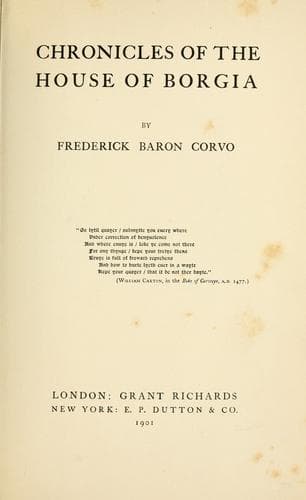
Borgia family; Borja, Francisco de, Saint, 1510-1572; Italy -- History -- 1492-1559
But, in the _rôle_ of an unconscionable villain, Duke Cesare was a
failure—an accented failure. Contrariwise, he comported himself as
exemplarily as any good and pious Catholic. Most likely his fever, or
the murderous remedies of his physicians, was responsible for this.
There is no doubt but that the scheme for a Borgia Dynasty had been
adumbrated; and that this was the psychological moment for giving it
concrete expression: but the death of the Lord Alexander P.P. VI, and
Duke Cesare’s own illness came with sobering effect to him; and his
course of action may be translated thus—that he resolved not to usurp
the prerogative of the Supreme Disposer of events. For a villain, the
resolve was weak: but it was what was to be expected of a splendid man
of sense.
Duke Cesare knew that he held his riches, his supremacy, his titles of
Duke of Romagna, Gonfalonier of the Holy Roman Church, and Castellan of
Santangelo, solely at the pleasure of the Pope; yet he made no effort to
secure the election of a Pope who would confirm his possession of them.
There is still in existence a ring of his, (they call it a “Poison
Ring”—but of that much has been said—) which bears the splendid motto
FAYS CEQUE DOYS AVIEN QUE POURRA
_Do thy duty, come what may._
That principle informed his action now. Duke Cesare did his duty.
He renewed his feudal oath of allegiance in the presence of the Sacred
College. He formally recognized the supremacy, during the interregnum,
of the Cardinal-Dean and the Cardinal-Chamberlain. He divested himself
of the semblance and reality of power, by relinquishing the Mola of
Hadrian (which impregnable fortress he held as Castellan of Santangelo,
and whence he could have overawed both the Vatican and Rome). Further,
finding that the mere presence of his army in the City was considered
disrespectful to the Conclave, he retired it to his province of the
Romagna; and he himself withdrew to France to his duchy of Valentinois.
So, the Conclave of 1503 met in absolute freedom; and elected, as
Successor of St. Peter, Ruler of the World, Father of Princes and of
Kings, and Earthly Vicar of Jesus Christ our Saviour, the Lord Francesco
de’ Piccolhuomini, Cardinal-Archdeacon of Sant’ Eustachio, Archbishop of
Siena, who deigned to be called the Lord Pius P. P. III, in memory of
His august uncle, the Lord Pius P. P. II[84] Who had reigned from 1458
to 1464.
Public-domain text, read in full here on John Shaqi.
Reviews
Reviews
No reviews yet
Be the first to share your thoughts on this work.
Elsewhere in the archive
Join the Discussion
Join the discussion
Sign in to leave a comment or review.
Sign InorCreate an account