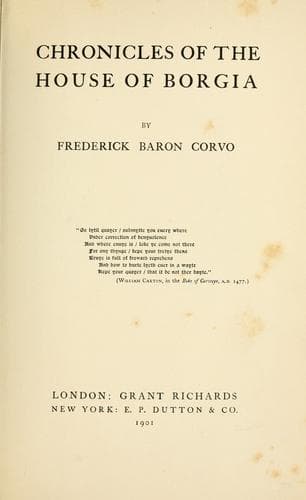
Borgia family; Borja, Francisco de, Saint, 1510-1572; Italy -- History -- 1492-1559
Whether the Lord Julius P.P. II had made, or had not made, promises
before His election, He was now _de iure_ and _de facto_ Ruler of the
World, and absolutely despotic. He arrested Duke Cesare in Rome; and
imprisoned him as a rebel in the Borgia Tower. The utter and vacuous
helplessness of the Duke is in striking contrast to the masterful energy
of all his previous life. Some enormous mental shock might produce such
degeneration; the hideous treachery of Cardinal Giuliano della Rovere as
related by Varillas, for example. Duke Cesare behaved, in his
misfortune, like a son staggered, struck breathless and speechless by a
revelation of a father’s iniquity. A Bull of Deprivation despoiled him
of all fiefs and dignities held from the Holy See, and confiscated all
his personal property. He literally was stripped naked. In 1504, he
escaped from Rome to Ostia in disguise, and thence to Naples. Here he
might have found a pied à terre; and, with the splendour of his past
achievements, have won an opportunity of recovering his lost estates by
war: but the Lord Julius P.P. II, conscious of the danger to His peace
that such an aggrieved and notable personality would be, had intrigued
with the Catholic King; and, on Duke Cesare’s arrival in the Regno, he
was re-arrested, and shipped to a new prison in the castle of Medina del
Campo in Spain.
* * * * *
The marriage of Madonna Lucrezia Borgia with Don Alfonso d’Este was a
most happy one. The sweet young bride had made herself beloved by all
Ferrara, from her husband’s father Duke Ercole to the meanest of his
subjects, by her beauty, her goodness, and her wonderfully able
versatility, three indispensable qualities in the wife of the heir to
the throne. Attired in “a mulberry satin gown embroidered with gold
fish-bones each two fingers broad,” with the lace-flounce worth thirty
thousand ducats (say £60,000) which, according to Giovanni Lucido, was
in her wedding-chest, she would amuse herself in the ducal palace by
witnessing performances of the _Casina_ or the _Miles Gloriosus_,
comedies of Plautus. Sometimes, (as Sanuto, the Venetian Orator at
Ferrara, informed his government,) she would remain all day in her
apartments, writing letters, and having her head washed: or she would
sit for hours and listen to the violin-music of her adept young husband.
On the Maundy Thursday of the first year of her marriage, she publicly
washed the feet of one hundred and sixty poor men. Her observance of
religious duties was as notable as the spirit of genuine piety which
pervades her many letters still extant.
Public-domain text, read in full here on John Shaqi.
Reviews
Reviews
No reviews yet
Be the first to share your thoughts on this work.
Elsewhere in the archive
Join the Discussion
Join the discussion
Sign in to leave a comment or review.
Sign InorCreate an account