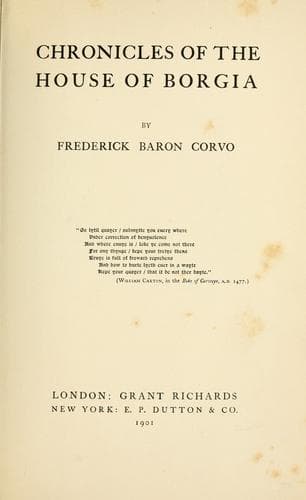
Borgia family; Borja, Francisco de, Saint, 1510-1572; Italy -- History -- 1492-1559
The Lord Julius P.P. II was capable of doing without Duke Cesare in the
Romagna. The Pope’s Holiness Himself was a man of war, Who found it
consistent to wear cuirass and casque on battlefields equally with
pluviale and triregno in the Vatican Basilica. Men called Him _Il
Pontifice Terribile_. “Give Us in Our hands no stupid book, but a bare
blade,” He impatiently roared to the painter of His portrait, now in the
National Gallery. But Messer Rafaele Sanzio, despite all his
conventional macaronics, was for once in his life artist enough to omit
both book and blade, and to concentrate on the painting of the character
of those fierce vulgar insatiable empty hands gripping the arms of the
chair. And the Romagna found the whips of Duke Cesare to be preferred
before the scorpions of the Lord Julius P.P. II. Perugia was the seat of
the Baglioni. Twenty years before, in 1487, there had been an outbreak
of the feud of Baglioni and Oddi, months of continual rioting, the
gutters running blood, the city like a slaughterhouse; until Oddi was
driven away, and Baglioni turned the place into a fortress and the
churches into barracks. In 1491, in another outbreak, Baglioni hanged a
hundred and thirty conspirators from the windows of the Palazzo
Communale in a single day; and, (with the quick reversion from carnage
to piety which is a characteristic of the age,) incontinently erected
five and thirty altars in the public square, and caused continuous
masses to be said and processions to be performed, to purify the city
and to procure repose for the souls of the slain. Duke Cesare made a
marked impression on these brigands, who learned to give him little
trouble: but, when he was dispossessed and his long sword sealed in its
scabbard, Baglioni took the bit between their teeth and reared, refused
tribute to their sovereign Over-lord, and broke out in rebellion in the
customary manner. The Lord Julius P.P. II promptly raised an army which
He led in person; and reduced Perugia. Without precautions for His
safety, trusting to the moral effect of His presence for the
inviolability of His sacrosanct person, He adventured Himself in the
heart of the rebel city, and beat Don Giampaolo Baglioni to his knees.
In a man of sensibility this hardihood would indicate a very dare-devil:
in the case of the Supreme Pontiff a distinction must be made between
courage and mere plebeian callousness. Messer Niccolo Machiavelli
sneered at this miserable Don Giampaolo Baglioni, because he lacked the
boldness to strangle his unwelcome visitor, the Lord Julius P.P. II, and
so crown his life of crime with a signal act of “Magnanimità”! Certainly
a man would need some boldness to strangle the Pope, the Ruler of the
World, the Father of Princes and of Kings, the Earthly Vicar of Jesus
Christ our Saviour! Certainly, a man who would strangle in cold blood
the Sovereign Pontiff coming to him as his guest, unarmed, under a flag
of truce, would win fame, or infamy, for endless ages.
Public-domain text, read in full here on John Shaqi.
Reviews
Reviews
No reviews yet
Be the first to share your thoughts on this work.
Elsewhere in the archive
Join the Discussion
Join the discussion
Sign in to leave a comment or review.
Sign InorCreate an account