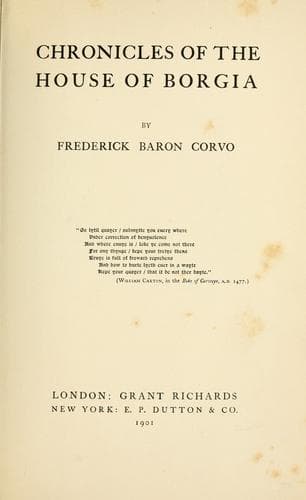
Borgia family; Borja, Francisco de, Saint, 1510-1572; Italy -- History -- 1492-1559
During this year, a league of the Powers was formed under the
Elect-Emperor Maximilian directed against Venice; and Duke Alfonso,
whose dominions marched with those of that Republic, threw in his lot
with its foes. While he was engaging the Venetians on the Romagna
frontier, the Duchess Lucrezia ruled as Regent in Ferrara. She
administered government of the state with the same sweet womanly
thoroughness as she shewed in the administration of the government of
her domestic affairs. History is rich in records relating to this lovely
lady. She superintended the household matters of her palaces with a
minute attention to detail which, to the modern middle-classes, would
appear amazing in a Sovereign Duchess. To set a fashion of rare
liberal-mindedness she appointed the Jewess Mazzolino to the care of her
extensive wardrobe, and Messer Ludovico as her physician. Her régime was
of the simple patriarchal type of the old Duke Ercole, who, on the
occasion of an outbreak of plague in 1500, issued an Edict which said
that “Duke Ercole d’Este, for good reasons to him known, _and because it
always is well to be on good terms with God_,” ordained religious
processions every day throughout Ferrara. A second quaint Edict of the
same fatherly potentate, (which incidentally speaks for the meticulously
cleanly personal habits of the Borgian Era, so strenuously maintained on
a previous page of this book,) proclaims that “inasmuch as bakers are
known to knead their dough with feet that, frequently, are unclean, such
practices must not continue except on penalty of fine or imprisonment:
but the dough must be worked with clean hands _and nails_.”
Public-domain text, read in full here on John Shaqi.
Reviews
Reviews
No reviews yet
Be the first to share your thoughts on this work.
Elsewhere in the archive
Join the Discussion
Join the discussion
Sign in to leave a comment or review.
Sign InorCreate an account