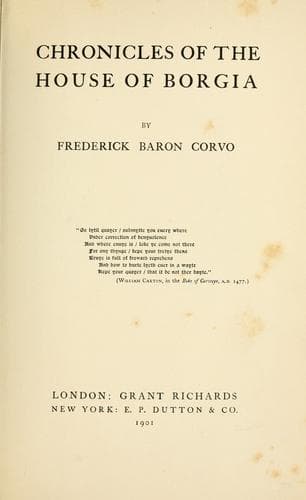
Borgia family; Borja, Francisco de, Saint, 1510-1572; Italy -- History -- 1492-1559
himself to expose his grievous wounds: but he may have it only at a
price which in honour he cannot pay—the price of insincerity to his
convictions—the price of apostasy. The dire Ban of excommunication,
formal or informal, drives a man wild; turns his hand against every man,
and every man’s hand against him; he is savage; he is a Bandit, actually
and literally. Sometimes he becomes criminal. Ostracism practised is a
school for scoundrels. Far more merciful—divinely merciful, not
humanly—it would be to slay outright the body; than to doom a soul to
live a solivagous life of torture—the torture of Hopelessness. That is
why Excommunication is so horrible in this present age of works. That is
why it was so trenchant a weapon in the ages of faith. It was, and is,
perfectly impossible to be resisted by one who is, and was, sincerely
faithful. Often enough, an excommunicate sovereign would try resistance;
for sovereigns are stronger than ordinary plebeians in the matter of
resources. Then, when an interval for consideration had elapsed, the
second blow of the Flail would fall—Interdict: his demesne would be made
to suffer loss of the means of grace, the sacraments, which were denied
to him. His subjects generally rose, resentful and revolting. There was
no reason why they should be afflicted, when submission of their
sovereign to God’s Vicegerent would suffice for their enfranchisement.
But sometimes Interdict also failed. The third blow came. Subjects were
absolved from their oath of allegiance to the excommunicate; his throne
was declared vacant; kings and princes of Christendom were invited to
invade his realm, to take his crown and sceptre, to expel him a homeless
friendless connudate outcast in a world that shunned him like a
pestilence, like the horrid leprous scab of creeping things which his
blasted human body inevitably would become. Then, suppliant, submissive,
he crawled to his Canossa; as the late Duke of Lauenberg crawled to the
Lord Leo P.P. XIII the other day; as Caesar Fridericus Ahenobarbus
Semper Augustus abjectly crawled to, and waited at, the gates of the
huge Englishman, Nicholas Breakespeare, the Lord Hadrian P.P. IV, who
ruled the world eight hundred years ago, “Not for thee, but for Peter,”
that indignant Emperor muttered, perforce doing groom’s service for
Peter’s Successor, holding the stirrup of the pontifical palfrey. “For
Us, _and_ for Peter,” the superb English Pope retorted, as He bent
Caesar to His unconquerable will. Arrogant? Arrogant——of any miserable
mortal man who did not believe himself to be, who had not been
officially crowned and saluted, and to whom every emperor and king and
prince of Christendom, every Christian sovereign and subject of Europe,
had not sworn allegiance as, “Ruler of the World, Father of Princes and
of Kings, Earthly Vicar of Jesus Christ our Saviour.”
Public-domain text, read in full here on John Shaqi.
Reviews
Reviews
No reviews yet
Be the first to share your thoughts on this work.
Elsewhere in the archive
Join the Discussion
Join the discussion
Sign in to leave a comment or review.
Sign InorCreate an account