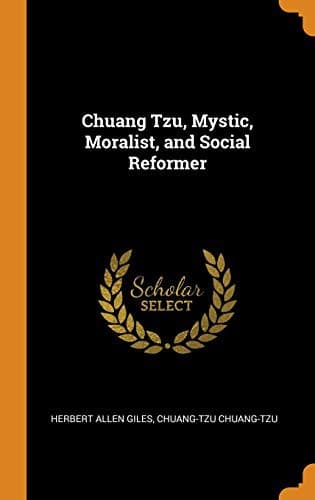
Chuang Tzu: Mystic, Moralist, and Social ReformerZhuangzi
Religion
Chuang Tzu: Mystic, Moralist, and Social Reformer
Zhuangzi
Ethics -- China; Philosophy, Chinese
A vulgar saying has it, "The masses value money; honest men, fame;
virtuous men, resolution; and Sages, the soul."
Thus, the pure is that in which there is nothing mixed; the simple is
that which implies no injury to the spirituality. And he who can keep
the pure and simple within himself,--he is a divine man.
It requires but scant acumen to relegate this chapter to the limbo of
forgeries. Lin Hsi Chung thinks it is probably from the hand of the
unknown artist who is responsible for ch. xiii.
CHAPTER XVI.
EXERCISE OF FACULTIES.
_Argument_:--TAO unattainable by mundane arts--To be reached through
repose--The world's infancy--The reign of peace--Government sets
in--TAO declines--The true Sages of old--Their purity of aim.
Those who exercise their faculties in mere worldly studies, hoping
thereby to revert to their original condition; and those who sink
their aspirations in mundane thoughts, hoping thereby to reach
enlightenment;--these are the dullards of the earth.
The ancients, in cultivating TAO, begat knowledge out of repose. When
born, this knowledge was not applied to any purpose; and so it may be
said that out of knowledge they begat repose. Knowledge and repose thus
mutually producing each other, harmony and order were developed. Virtue
is harmony; TAO is order.
Virtue all-embracing,--hence charity. TAO all-influencing,--hence
duty to one's neighbour. From the establishment of these two springs
loyalty. Then comes music, an expression of inward purity and truth;
followed by ceremonial, or sincerity expressed in ornamental guise. If
music and ceremonial are ill regulated, the empire is plunged into
confusion. And to attempt to correct others while one's own virtue is
clouded, is to set one's own virtue a task for which it is inadequate,
the result being that the natural constitution of the object will
suffer.
Primeval man enjoyed perfect tranquillity throughout life. In his day,
the Positive and Negative principles were peacefully united; spiritual
beings gave no trouble; the four seasons followed in due order; nothing
suffered any injury; death was unknown; men had knowledge, but no
occasion to use it. This may be called perfection of unity.
All things, all conditions, were ONE.
At that period, nothing was ever made so; but everything was so.
By and by, virtue declined. Sui Jen
The Prometheus of China.
and Fu Hsi
See ch. vi.
ruled the empire. There was still natural adaptation,
Of man to his surroundings.
but the unity was gone.
The tide of coercion had set in.
A further decline in virtue. Shên Nung
The inventor of agriculture.
and Huang Ti
The Yellow Emperor. See ch. vi.
ruled the empire. There was peace, but the natural adaptation was gone.
Again virtue declined. Yao and Shun ruled the empire. Systems of
government and moral reform were introduced. Man's original integrity
was scattered. Goodness led him astray from TAO;
But for goodness, evil could not exist.
Public-domain text, read in full here on John Shaqi.
Reviews
Reviews
No reviews yet
Be the first to share your thoughts on this work.
Elsewhere in the archive
Join the Discussion
Join the discussion
Sign in to leave a comment or review.
Sign InorCreate an account