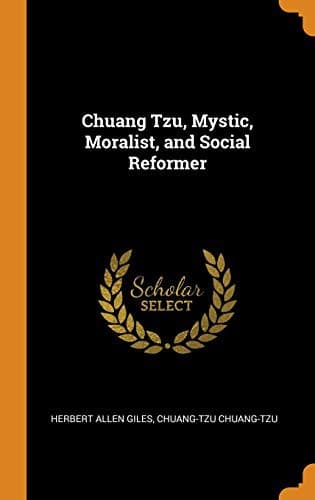
Chuang Tzu: Mystic, Moralist, and Social ReformerZhuangzi
Religion
Chuang Tzu: Mystic, Moralist, and Social Reformer
Zhuangzi
Ethics -- China; Philosophy, Chinese
"Then man goes back into the great Scheme, from which all things come
and to which all things return."
Such is the eternal round, marked by the stages which we call life and
death.
Many of the names in the above paragraph have not been identified even
by Chinese commentators. On all counts then they may safely be left
where they are.
CHAPTER XIX.
THE SECRET OF LIFE.
_Argument_:--The soul is from God--Man's body its vehicle--The soul
quickening the body is life--Care of the internal and of the external
must be simultaneous--In due nourishment of both is TAO.
[This chapter is supplementary to chapter iii.]
Those who understand the conditions of life devote no attention
to things which life cannot accomplish. Those who understand the
conditions of destiny devote no attention to things over which
knowledge has no control.
For the due nourishment of our physical frames, certain things are
needful. Yet where such things abound, the physical frame is not always
nourished. For the preservation of life it is necessary that there
should be no abandonment of the physical frame. Yet where the physical
frame is not abandoned, life does not always remain.
Life comes, and cannot be declined. It goes, and cannot be stopped.
But alas! the world thinks that to nourish the frame is enough to keep
life. And if indeed it is not enough, what then is the world to do?
Although not enough, it must still be done. It cannot be neglected. For
if one is to neglect the physical frame, better far to retire at once
from the world. By renouncing the world, one gets rid of the cares
of the world. The result is a natural level, which is equivalent to a
re-birth. And he who is re-born is near.
To TAO.
But what inducement is there to renounce the affairs of men, to become
indifferent to life?--In the first case, the physical body suffers no
wear and tear; in the second, the vitality is left unharmed. And he
whose physical frame is perfect and whose vitality is in its original
purity,--he is one with God.
Mens sana in corpore sano.
Heaven and earth are the father and mother of all things. When they
unite, the result is shape. When they disperse, the original condition
is renewed.
As in the case of ordinary mortals.
But if body and vitality are both perfect, this state is called _fit
for translation_.
In the Biblical sense, as applied to Enoch.
Such perfection of vitality goes back to the minister of God.
"Vitality" is the subtle essence, the immaterial informing principle
which, united with matter, exhibits the phenomenon of life. The term
has already occurred in ch. xi.
* * * * *
Lieh Tzŭ asked Kuan Yin,
A sage who by some is said to have flourished five or six hundred
years before Lieh Tzŭ; by others, to have been an immediate disciple
of Lao Tzŭ, and to have been entrusted by him with the publication of
the _Tao-Tê-Ching_.
Public-domain text, read in full here on John Shaqi.
Reviews
Reviews
No reviews yet
Be the first to share your thoughts on this work.
Elsewhere in the archive
Join the Discussion
Join the discussion
Sign in to leave a comment or review.
Sign InorCreate an account