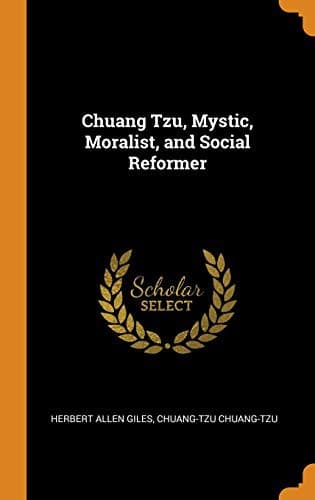
Chuang Tzu: Mystic, Moralist, and Social ReformerZhuangzi
Religion
Chuang Tzu: Mystic, Moralist, and Social Reformer
Zhuangzi
Ethics -- China; Philosophy, Chinese
"The art of preserving life," replied Lao Tzŭ, "consists in being able
to keep all in ONE,
_Sc._ Body and soul. See the _Tao-Tê-Ching_, ch. x, where this idea
has been reproduced.
to lose nothing, to estimate good and evil without divination,
To know that each is bound up in the other.
to know when to stop, and how much is enough, to leave others alone
and attend to oneself, to be without cares and without knowledge,--to
be in fact as a child. A child will cry all day and not become hoarse,
because of the perfection of its constitutional harmony.
Also reproduced in the _Tao-Tê-Ching_, ch. lv.
It will keep its fist tightly closed all day and not open it, because
of the concentration of its virtue. It will gaze all day without taking
off its eyes, because its sight is not attracted by externals. In
motion, it knows not whither it is bound; at rest, it is not conscious
of doing anything; but unconsciously adapts itself to the exigencies of
its environment. This is the art of preserving life."
"Is this then the virtue of the perfect man?" cried Nan Yung.
"Not so," said Lao Tzŭ. "I am, as it were, but breaking the ice.
"The perfect man shares the food of this earth, but the happiness of
God. He does not incur trouble either from men or things. He does not
join in censuring, in plotting, in toadying. Free from care he comes,
and unconscious he goes;--this is the art of preserving life."
"This then is perfection?" inquired Nan Yung.
"Not yet," said Lao Tzŭ. "I specially asked if you could be as a child.
A child acts without knowing what it does; moves without knowing
whither. Its body is like a dry branch; its heart like dead ashes.
Thus, good and evil fortune find no lodgment therein; and there where
good and evil fortune are not, how can the troubles of mortality be?
"Those whose hearts are in a state of repose give forth a divine
radiance, by the light of which they see themselves as they are. And
only by cultivating such repose can man attain to the constant.
"Those who are constant are sought after by men and assisted by God.
Those who are sought after by men are the people of God; those who are
assisted by God are his chosen children.
The stuff of which rulers are made.
"To study this is to study what cannot be learnt. To practise this is
to practise what cannot be accomplished. To discuss this is to discuss
what can never be proved. Let knowledge stop at the unknowable. That
is perfection. And for those who do not follow this, God will destroy
them!
"Knowledge," says Emerson in his _Montaigne, or the Sceptic_, "is the
knowing that we cannot know."
"With such defences for the body, ever prepared for the unexpected,
deferential to the rights of others,--if then calamities overtake you,
these are from God, not from man. Let them not disturb what you have
already achieved. Let them not penetrate into the soul's abode. For
there resides the Will. And if the will knows not what to will, it will
not be able to will.
Public-domain text, read in full here on John Shaqi.
Reviews
Reviews
No reviews yet
Be the first to share your thoughts on this work.
Elsewhere in the archive
Join the Discussion
Join the discussion
Sign in to leave a comment or review.
Sign InorCreate an account