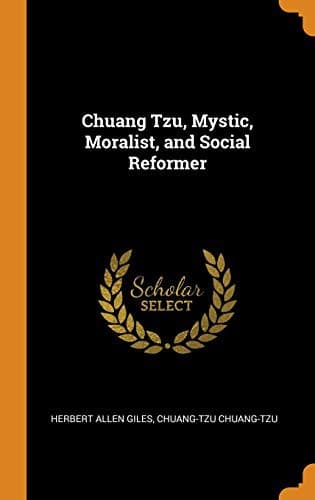
Chuang Tzu: Mystic, Moralist, and Social ReformerZhuangzi
Religion
Chuang Tzu: Mystic, Moralist, and Social Reformer
Zhuangzi
Ethics -- China; Philosophy, Chinese
"What do you mean?" asked Yeh Ch'üeh.
"Yao," said Hsü Yu, "thinks of nothing but charity. I fear he will
become a laughing-stock to the world, and that in future ages men will
eat one another.
See p. 296.
"There is no difficulty in winning the people. Love them and they will
draw near. Profit them and they will come up. Praise them and they will
vie with one another. But introduce something they dislike, and they
will be gone.
"Love and profit are born of charity and duty to one's neighbour. Those
who ignore charity and duty to one's neighbour are few; those who make
capital out of them are many.
"For the operation of these virtues is not disinterested. It is like
lending gear to a sportsman.
With a view to share the game.
Wherefore, for one man to dogmatise for the good of the whole empire,
is like splitting a thing at a single blow.
Without reference to method or the requirements of the case in point.
"Yao knows that good men benefit the empire. But he does not know that
they injure it. Only those on a higher level than good men know this.
"There are nincompoops; there are parasites; there are enthusiasts.
"A man who learns from a single teacher, and then goes off exultant,
satisfied with his acquirements though ignorant that there was a time
when nothing existed,--such a one is a nincompoop.
"Parasites are like the lice on a pig's back. They choose bald patches,
which are to them palaces and parks. The parts between the toes, the
joints, the dugs, and the buttocks, are to them so many comfortable and
convenient resting-places. They know not that one day the butcher will
tuck up his sleeves and spread straw and apply fire, and that they will
perish in the singeing of the pig. As they sow, so do they reap. This
is to be a parasite.
"Of enthusiasts, Shun is an example. Mutton does not care for ants; it
is the ants which care for the mutton. Mutton has a frowsy smell; and
there is a frowsiness about Shun which attracts the people. Therefore
it was that after three changes of residence, when he came to the Têng
district, he had some hundred thousand families with him.
"Then Yao, hearing of his goodness, appointed him to a barren region,
trusting, as he said, that Shun's arrival would enrich it. When Shun
took up this appointment, he was already old, and his intellect was
failing; yet he would not cease work and retire from office. He was, in
fact, an enthusiast.
"So it is that the spiritual man dislikes a crowd. For where there is a
crowd there is diversity, and where there is diversity advantage does
not accrue. He is therefore neither very intimate, nor very distant. He
clings to virtue and nourishes a spirit of harmony, in order to be in
accord with his fellow-men. This is to be a divine man.
"Leave wisdom to ants. Strive for what fishes desire.
To be left alone in the water.
Public-domain text, read in full here on John Shaqi.
Reviews
Reviews
No reviews yet
Be the first to share your thoughts on this work.
Elsewhere in the archive
Join the Discussion
Join the discussion
Sign in to leave a comment or review.
Sign InorCreate an account