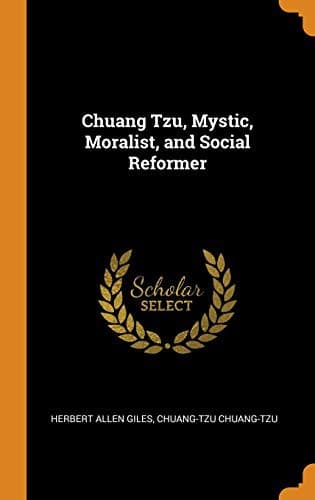
Chuang Tzu: Mystic, Moralist, and Social ReformerZhuangzi
Religion
Chuang Tzu: Mystic, Moralist, and Social Reformer
Zhuangzi
Ethics -- China; Philosophy, Chinese
"The mountains of Ch'i are its edge. Chin and Wei are its back. Chou
and Sung are its hilt. Han and Wei are its sheath. It is enclosed in
the four hordes of barbarians, wrapped in the four seasons, surrounded
by the great ocean. It is made of the five elements. It is the arbiter
of punishment and reward. It operates under the influence of the Yin
and the Yang. In spring and summer it is at rest. In autumn and winter
it moves abroad. Push it, it does not advance. Raise it, it does not go
up. Lower it, it does not go down. Whirl it around, it does not change
position. Above, it cleaves the floating clouds; below, it cuts through
the density of earth. One flash of this blade, and the princes of the
empire submit. Such is the sword of the Son of Heaven."
At this the prince seemed absorbed in his reflections. Then he
enquired, saying, "And what is the sword of the Princes?"
"The Wise and brave," replied Chuang Tzŭ, "are its point. The
incorruptible are its edge. The virtuous are its back. The loyal are
its hilt. The heroic are its sheath. You may push this sword too, it
will not advance. Raise it, it will not go up. Lower it, it will not go
down. Whirl it around, it will not change position. Above, it models
itself upon the round heaven, in order to keep in harmony with the sun,
moon, and stars. Below, it models itself upon the square earth, in
order to keep in harmony with the four seasons. It adapts itself to the
wishes of the people, in order to diffuse peace on all sides. One flash
of this blade is like a roaring clap of thunder. Between the boundaries
of the State there is not left one but who yields and obeys the command
of his prince. Such is the sword of the Princes."
"And the sword of the People?" enquired the prince.
"The sword of the People," replied Chuang Tzŭ, "has dishevelled hair
hanging over its temples. It wears a slouching cap with coarse tangled
tassel, and a short-tailed coat. It glares with its eyes and talks in
a fierce tone. When it engages in conflict, above, it cuts off head
and neck; below, it smites liver and lungs. Such is the sword of the
People. It is like a game-cock. One day, its life is cut short, and it
is of no more use to the State.
"Now you, great prince, wield sovereign power, and yet you devote
yourself to this sword of the People. I am truly ashamed of it."
Thereupon the prince drew Chuang Tzŭ up on to the dais, and the
attendants served food, the king three times assisting with his own
hand.
The prince each time received the dish from the attendants, handed it
to Chuang Tzŭ, and then walked _round_ to his own seat again.
"Be seated, great prince," said Chuang Tzŭ, "and compose your mind. I
have said all I have to say on swords."
After this the prince did not quit his palace for three months, while
the swordsmen, submitting to the new order of things, died in their own
homes.
Public-domain text, read in full here on John Shaqi.
Reviews
Reviews
No reviews yet
Be the first to share your thoughts on this work.
Elsewhere in the archive
Join the Discussion
Join the discussion
Sign in to leave a comment or review.
Sign InorCreate an account