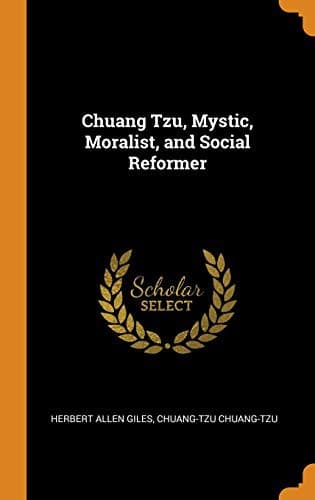
Chuang Tzu: Mystic, Moralist, and Social ReformerZhuangzi
Religion
Chuang Tzu: Mystic, Moralist, and Social Reformer
Zhuangzi
Ethics -- China; Philosophy, Chinese
"To know one's faults but not to correct them, to receive admonition
but only to plunge deeper,--this is obstinacy.
"To suffer those who are like oneself, but as for those unlike not to
credit them with the virtues they really possess,--this is bigotry.
"Such are the four things which obstruct business. And only he who can
put aside the above eight and abstain from the above four is fit for
instruction."
At this Confucius heaved a sigh of distress. Then having twice
prostrated himself, he arose and said, "Twice was I driven from Lu. I
was tabooed in Wei. My tree was cut down in Sung. I was surrounded by
the Ch'êns and the Ts'ais. I know not what my fault is that I should
have suffered these four persecutions."
"Dear me!" said the old man in a vexed tone, "How slow of perception
you are.
"There was once a man who was so afraid of his shadow and so disliked
his own footsteps that he determined to run away from them. But the
oftener he raised his feet the more footsteps he made, and though he
ran very hard his shadow never left him. From this he inferred that
he went too slowly, and ran as hard as he could without resting, the
consequence being that his strength broke down and he died. He was not
aware that by going into the shade he would have got rid of his shadow,
and that by keeping still he would have put an end to his footsteps.
Fool that he was!
"Now you occupy yourself with charity and duty to one's neighbour. You
examine into the distinction of like and unlike, the changes of motion
and rest, the canons of giving and receiving, the emotions of love and
hate, and the restraint of joy and anger. Yet you cannot avoid the
calamities you speak of.
"Reverently care for your body. Carefully preserve your natural
purity. Leave externals to others. Then you will not be involved. But
as it is, instead of improving yourself you are trying to improve other
people. Surely this is dealing with the external."
"Then may I enquire," said Confucius in a tone of distress, "what is
the original purity?"
"Our original purity," replied the fisherman, "is the perfection of
truth unalloyed. Without this, we cannot influence others. Hence, those
who weep to order, though they mourn, do not grieve. Those who assume
anger, though violent, do not inspire awe. Those who affect friendship,
though they smile, are not in unison."
"Real mourning grieves in silence. Real anger awes without expression.
Real friendship is unison without the aid of smiles. Our emotions are
dependent upon the original purity within; and accordingly we hold the
latter in esteem.
"If applied to human affairs, then in serving our parents we are
filial, in serving our prince we are loyal, in the banquet hour we are
merry, in the hour of mourning we are sad.
"The object of loyalty is successful service; of a banquet, mirth; of
mourning, grief; of serving parents, gratifying their wishes. If the
service is accomplished, it matters not that no trace remain.
Public-domain text, read in full here on John Shaqi.
Reviews
Reviews
No reviews yet
Be the first to share your thoughts on this work.
Elsewhere in the archive
Join the Discussion
Join the discussion
Sign in to leave a comment or review.
Sign InorCreate an account