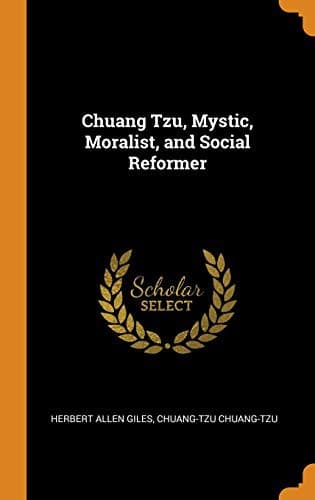
Chuang Tzu: Mystic, Moralist, and Social ReformerZhuangzi
Religion
Chuang Tzu: Mystic, Moralist, and Social Reformer
Zhuangzi
Ethics -- China; Philosophy, Chinese
It may be asked whence our spirituality, whence our intellectuality.
The true Sage is born; the prince is made. Yet all proceed from an
original ONE.
He who does not separate from the Source is one with God. He who
does not separate from the essence is a spiritual man. He who does
not separate from the reality is a perfect man. He who makes God the
source, and TÊ the root, and TAO the portal, passively falling in with
the modifications of his environment,--he is the true Sage.
These are but four different denominations of the ideal man.
He who practises charity as a kindness, duty to one's neighbour as a
principle, ceremony as a convenience, music as a pacificator, and thus
becomes compassionate and charitable,--he is a superior man.
We sink here to a lower level, though still a high one. The "superior
man" is the ideal man of Confucian ethics. In him divinity finds no
place.
He who regulates his conduct by law, who regards fame as an external
adjunct, who verifies his hypotheses, who bases his judgment upon
proof,--such men rank one, two, three, four, etc. It is thus that
officials rank. In a strict sense of duty, in making food and raiment
of paramount importance, in caring for and nourishing the old, the
weak, the orphan, and the widow, they all exemplify the principle of
true government.
Partly, if not wholly. This the dead level of ordinary mortality,
still within the operation of TAO.
Thus far-reaching was the extension of TAO among the ancients.
The companion of the gods, the purifier of the universe, it nourishes
all creation, it unites the empire, it benefits the masses.
Illuminating the fundamental, it is bound up with the accessory,
reaching to all points of the compass and to the opposite extremes of
magnitude. There is indeed nowhere where it is not!
How it enlightened the polity of past ages is evidenced in the records
which historians have preserved to us. Its presence in the Canons
of _Poetry_, _History_, _Rites_, and _Music_, has been made clear
by many scholars of Chou and Lu. It informs the Canon of _Poetry_
with its vigour, the Canon of _History_ with its usefulness, the
Canon of _Rites_ with its adaptability, the Canon of _Music_ with its
harmonising influence, the Canon of _Changes_ with its mysterious
Principles, and the _Spring and Autumn_ with its discriminations.
Spread over the whole world, it is focussed in the Middle Kingdom, and
the learning of all schools renders constant homage to its power.
But when the world is disorganised, true Sages do not manifest
themselves, TAO ceases to exist as ONE, and the world becomes cognisant
of the idiosyncrasies of the individual. These are like the senses of
hearing, sight, smell, and taste,--not common to each organ. Or like
the skill of various artisans,--each excellent of its kind and each
useful in its turn, but not equally at the command of all.
Public-domain text, read in full here on John Shaqi.
Reviews
Reviews
No reviews yet
Be the first to share your thoughts on this work.
Elsewhere in the archive
Join the Discussion
Join the discussion
Sign in to leave a comment or review.
Sign InorCreate an account