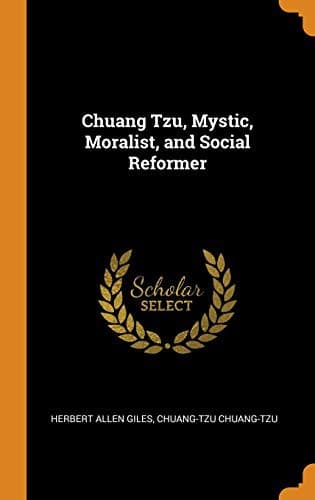
Chuang Tzu: Mystic, Moralist, and Social ReformerZhuangzi
Religion
Chuang Tzu: Mystic, Moralist, and Social Reformer
Zhuangzi
Ethics -- China; Philosophy, Chinese
He would have men toil through life and hold death in contempt. But
this teaching is altogether too unattractive. It would land mankind in
sorrow and lamentation. It would be next to impossible as a practical
system, and cannot, I fear, be regarded as the TAO of the true Sage.
It would be diametrically opposed to human passions, and as such would
not be tolerated by the world. Mih Tzŭ himself might be able to carry
it out; but not the rest of the world. And when one separates from the
rest of the world, his chances of developing an ideal State become
small indeed.
Mih Tzŭ argued in favour of his system as follows:--Of old, the great
Yü drained off the flood of waters, and caused rivers and streams to
flow through the nine divisions of the empire and the parts adjacent
thereto,--three hundred great rivers, three thousand branches, and
streams without number. With his own hands he plied the bucket and
dredger, in order to reduce confusion to uniformity,
Make all streams flow to the sea.
until his calves and shins had no hair left upon them. The wind bathed
him, the rain combed him; but he marked out the nations of the world,
and was in very truth a Sage. And because he thus sacrificed himself to
the commonwealth, ages of Mihists to come would also wear short serge
jackets and straw sandals, and toil day and night without stopping,
making self-mortification their end and aim, and say to themselves, "If
we cannot do this, we do not follow the TAO of Yü, and are unworthy to
be called Mihists."
The disciples of Hsiang Li Ch'in,
A professor of Mihism.
the followers of the five princes, Mihists of the south, such as K'u
Huo, Chi Ch'ih, and Têng Ling,--all these studied the canon of Mih Tzŭ,
but their disagreements and agreements were not identical. They called
each other schismatics, and quarrelled over the "hard and white," the
"like and unlike," and argued over questions of "odd and even." Chü
Tzŭ was their Sage, and they wanted to canonise him as a saint, that
they might carry on his doctrines into after ages. Even now these
differences are not settled.
Thus we see that Mih Tzŭ and Ch'in Hua Li, while right in theory, were
wrong in practice. They would merely have taught mankind to vie with
each other in working the hair off their calves and shins. The evil of
that system would have predominated over the good. Nevertheless, Mih
Tzŭ was undoubtedly a well-meaning man. In spite of failure, with all
its withering influences, he stuck to his text. He may be called a man
of genius.
But not a true Sage.
Not to be involved in the mundane, not to indulge in the specious, not
to be overreaching with the individual, nor antagonistic to the public;
but to desire the tranquillity of the world in general with a view
to the prolongation of life, to seek no more than sufficient for the
requirements of oneself and others, and by such a course to purify the
heart,--herein lay the TAO of the ancients.
Public-domain text, read in full here on John Shaqi.
Reviews
Reviews
No reviews yet
Be the first to share your thoughts on this work.
Elsewhere in the archive
Join the Discussion
Join the discussion
Sign in to leave a comment or review.
Sign InorCreate an account