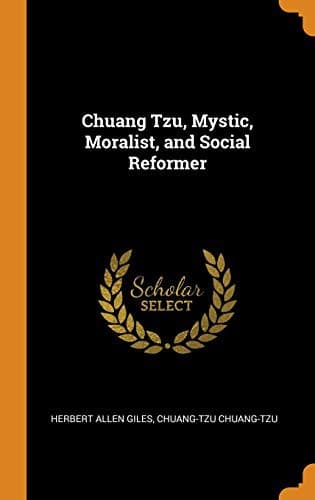
Chuang Tzu: Mystic, Moralist, and Social ReformerZhuangzi
Religion
Chuang Tzu: Mystic, Moralist, and Social Reformer
Zhuangzi
Ethics -- China; Philosophy, Chinese
He who knows what God is, and who knows what Man is, has attained.
Knowing what God is, he knows that he himself proceeded therefrom.
Knowing what Man is, he rests in the knowledge of the known, waiting
for the knowledge of the unknown. Working out one's allotted span, and
not perishing in mid career,--this is the fulness of knowledge.
God is a principle which exists by virtue of its own intrinsicality,
and operates spontaneously, without self-manifestation.
It is in the human that the divine finds expression. Man emanates from
God, and should therefore be on earth, in this brief life of ours,
what God is for all eternity in the universe.
Herein, however, there is a flaw. Knowledge is dependent upon
fulfilment. And as this fulfilment is uncertain, how can it be known
that my divine is not really human, my human really divine?
Not until death lifts the veil can we truly know that this life
is bounded at each end by an immortality to which the soul finally
reverts.
"Heaven from all creatures hides the book of Fate,
All but the page prescribed, their present state."
We must have _pure men_, and then only can we have _pure knowledge_.
"Pure" must be understood in the sense of transcendent.
But what is a pure man?--The pure men of old acted without calculation,
not seeking to secure results. They laid no plans. Therefore, failing,
they had no cause for regret; succeeding, no cause for congratulation.
And thus they could scale heights without fear; enter water without
becoming wet; fire, without feeling hot. So far had their wisdom
advanced towards TAO.
"The world-spirit is a good swimmer, and storms and waves cannot drown
him."--_Emerson._
The pure men of old slept without dreams, and waked without anxiety.
They ate without discrimination, breathing deep breaths. For pure men
draw breath from their uttermost depths; the vulgar only from their
throats.
"Uttermost depths" is literally "heels," but all the best commentators
take the sentence to mean that pure men breathe with their whole
being, and not as it were superficially, from the throat only.
This passage is probably responsible for the trick of taking deep
inhalations of morning air, practised (not without scientific
foundation) by the followers of the debased Taoism of modern times.
Other tricks for prolonging life, such as swallowing the saliva three
times in every two hours, etc., are more open to adverse criticism.
See the _T'ai-Hsi-Ching_.
Out of the crooked, words are retched up like vomit. If men's passions
are deep, their divinity is shallow.
Public-domain text, read in full here on John Shaqi.
Reviews
Reviews
No reviews yet
Be the first to share your thoughts on this work.
Elsewhere in the archive
Join the Discussion
Join the discussion
Sign in to leave a comment or review.
Sign InorCreate an account