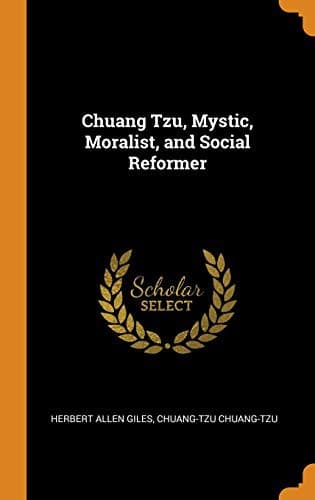
Chuang Tzu: Mystic, Moralist, and Social ReformerZhuangzi
Religion
Chuang Tzu: Mystic, Moralist, and Social Reformer
Zhuangzi
Ethics -- China; Philosophy, Chinese
For, given territory, there is the great thing--Man. Given man, he must
not be managed as if he were a mere thing; though by not managing him
at all he may actually be managed as if he were a mere thing. And for
those who understand that the management of man as if he were a mere
thing is not the way to manage him, the issue is not confined to mere
government of the empire. Such men may wander at will between the six
limits of space or travel over the continent of earth, unrestrained in
coming and in going. This is to be distinguished from one's fellows,
and this distinction is the highest attainable by man.
The doctrine of the perfect man is to him as shadow to form, as echo to
sound. Ask and it responds, fulfilling its mission as the help-mate of
humanity. Noiseless in repose, objectless in motion, it guides you to
the goal, free to come and free to go for ever without end. Alone in
its exits and its entrances, it rivals the eternity of the sun.
As for his body, that is in accordance with the usual standard. Being
in accordance with the usual standard it is not distinguished in
any way. But if not distinguished in any way, what becomes of the
distinction by which he is distinguished?
Those who see what is to be seen,--of such were the perfect men of
old. Those who see what is not to be seen,--they are the chosen of the
universe.
Spiritual sight carries them beyond the horizon where natural vision
stops short.
Low in the scale, but still to be allowed for,--matter. Humble, but
still to be followed,--
Rather than guided.
mankind. Of others, but still to be attended to,--affairs. Harsh,
but still necessary to be set forth,--the law. Far off, but still
claiming our presence,--duty to one's neighbour. Near, but still
claiming extension,--charity. Of sparing use, but still to be of
bounteous store,--ceremony. Of middle course, but still to be of
lofty scope,--virtue. One, but not to be without modification,--TAO.
Spiritual, yet not to be devoid of action,--GOD.
In inaction there is action.
Therefore the true Sage looks up to God, but does not offer to aid. He
perfects his virtue, but does not involve himself. He guides himself by
Tao, but makes no plans. He identifies himself with charity, but does
not rely on it. He extends to duty towards his neighbour, but does not
store it up. He responds to ceremony, without tabooing it.
Although really recognising only the ceremony of the heart which
requires no outward sign.
He undertakes affairs without declining them. He metes out law without
confusion. He relies on his fellow-men and does not make light of them.
He accommodates himself to matter and does not ignore it.
Thus the action of the Sage is after all inaction.
While there should be no action, there should be also no inaction.
Of a positive, premeditated character.
Public-domain text, read in full here on John Shaqi.
Reviews
Reviews
No reviews yet
Be the first to share your thoughts on this work.
Elsewhere in the archive
Join the Discussion
Join the discussion
Sign in to leave a comment or review.
Sign InorCreate an account