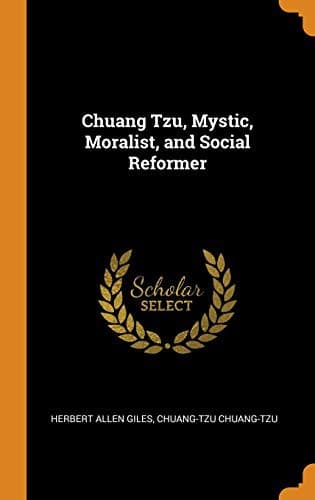
Chuang Tzu: Mystic, Moralist, and Social ReformerZhuangzi
Religion
Chuang Tzu: Mystic, Moralist, and Social Reformer
Zhuangzi
Ethics -- China; Philosophy, Chinese
This "Master" has been identified with both Chuang Tzŭ and Lao Tzŭ.
"To act by means of inaction is God. To speak by means of inaction
is Virtue. To love men and care for things is Charity. To recognise
the unlike as the like is breadth of view. To make no distinctions is
liberal. To possess variety is wealth. And so, to hold fast to virtue
is strength. To complete virtue is establishment. To follow TAO is to
be prepared. And not to run counter to the natural bias of things is to
be perfect.
"He who fully realises these ten points, by storing them within
enlarges his heart, and with this enlargement brings all creation to
himself. Such a man will bury gold on the hillside and cast pearls
into the sea. He will not struggle for wealth, nor strive for fame. He
will not rejoice at old age, nor grieve over early death. He will find
no pleasure in success, no chagrin in failure. He will not account a
throne as his own private gain, nor the empire of the world as glory
personal to himself. His glory is to know that all things are ONE, and
that life and death are but phases of the same existence!"
"Let man learn that he is here, not to work, but to be worked upon;
and that, though abyss open under abyss, and opinion displace opinion,
all are at last contained in the Eternal Cause." _Emerson._
The Master said, "How profound in its repose, how infinite in its
purity, is TAO!
"If metal and stone were without TAO, they would not be capable of
emitting sound. And just as they possess the property of sound but
will not emit sound unless struck, so surely is the same principle
applicable to all creation.
Meaning that all creation is responsive to proper influences, in
accordance with TAO, if we only knew where to seek them.
"The man of complete virtue remains blankly passive as regards what
goes on around him. He is as originally by nature, and his knowledge
extends to the supernatural. Thus, his virtue expands his heart, which
goes forth to all who come to take refuge therein.
His heart does not initiate the movement, but simply responds to an
influence brought to bear.
"Without TAO, form cannot be endued with life. Without virtue, life
cannot be endued with intelligence. To preserve one's form, live out
one's life, establish one's virtue, and realise TAO,--is not this
complete virtue?
"Issuing forth spontaneously, moving without premeditation, all things
following in his wake,--such is the man of complete virtue!
"He can see where all is dark. He can hear where all is still. In the
darkness he alone can see light. In the stillness he alone can detect
harmony. He can sink to the lowest depths of materialism. To the
highest heights of spirituality he can soar. This because he stands in
due relation to all things. Though a mere abstraction, he can minister
to their wants, and ever and anon receive them into rest,--the great,
the small, the long, the short, for ever without end."
He is, as it were, a law of compensation to all things.
Public-domain text, read in full here on John Shaqi.
Reviews
Reviews
No reviews yet
Be the first to share your thoughts on this work.
Elsewhere in the archive
Join the Discussion
Join the discussion
Sign in to leave a comment or review.
Sign InorCreate an account