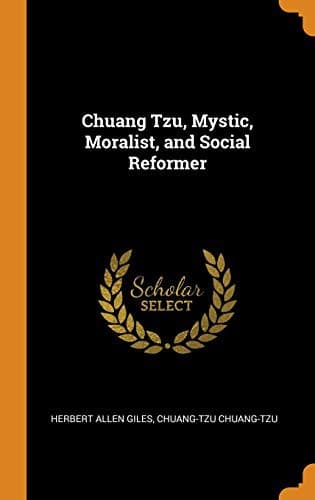
Chuang Tzu: Mystic, Moralist, and Social ReformerZhuangzi
Religion
Chuang Tzu: Mystic, Moralist, and Social Reformer
Zhuangzi
Ethics -- China; Philosophy, Chinese
Therefore, those of old who apprehended TAO, first apprehended God.
TAO came next, and then charity and duty to one's neighbour, and
then the functions of public life, and then forms and names, and
then employment according to capacity, and then distinctions of good
and bad, and then discrimination between right and wrong, and then
rewards and punishments. Thus wise men and fools met with their dues;
the exalted and the humble occupied their proper places. And the
virtuous and the worthless being each guided by their own natural
instincts, it was necessary to distinguish capabilities, and to adopt
a corresponding nomenclature, in order to serve the ruler, nourish the
ruled, administer things generally, and elevate self. Where knowledge
and plans are of no avail, one must fall back upon the natural. This
is perfect peace, the acme of good government. Therefore it has been
written, "Wherever there is form, there is also its name." Forms and
names indeed the ancients had, but did not give precedence to them.
Thus, those of old who considered TAO, passed through five phases
before forms and names were reached, and nine before rewards and
punishments could be discussed.
As given in the preceding paragraph.
To rise _per saltum_ to forms and names is to be ignorant of their
source; to rise _per saltum_ to rewards and punishments is to be
ignorant of their beginning. Those who invert the process of discussing
TAO, arguing in a directly contrary sense, are rather to be governed by
others than able to govern others themselves.
To rise _per saltum_ to forms and names and rewards and punishments,
this is to understand the instrumental part of government, but not to
understand the great principle of government.
Which is TAO.
This is to be of use in the administration of the empire, but not to
be able to administer the empire. This is to be a sciolist, a man of
narrow views.
Ceremonies and laws were indeed cultivated by the ancients; but they
were employed in the service of the rulers by the ruled. Rulers did not
employ them as a means of nourishing the ruled.
From the beginning of this chapter, the argument has been eminently
unsatisfactory.
Of old, Shun asked Yao, saying, "How does your Majesty employ your
faculties?"
"I am not arrogant towards the defenceless," replied Yao. "I do not
neglect the poor. I grieve for those who die. I pity the orphan. I
sympathise with the widow. Beyond this, nothing."
"Good indeed!" cried Shun, "but yet not great."
"How so?" inquired Yao.
"Be passive," said Shun, "like the virtue of God. The sun and moon
shine; the four seasons revolve; day and night alternate; clouds come
and rain falls."
"Alas!" cried Yao, "what a muddle I have been making. You are in accord
with God; I am in accord with man."
Public-domain text, read in full here on John Shaqi.
Reviews
Reviews
No reviews yet
Be the first to share your thoughts on this work.
Elsewhere in the archive
Join the Discussion
Join the discussion
Sign in to leave a comment or review.
Sign InorCreate an account