"The mistakes and the sufferings of human life make me think sometimes
that those ancient seers, or Interpreters of the secrets of heaven and the
counsels of the Divine mind, had some glimpse of the truth, when they said
that men are born in order to suffer the penalty for some sins committed
in a former life; and that the idea is true which we find in Aristotle,
that we are suffering some such punishment as theirs of old, who fell into
the hands of those Etruscan bandits, and were put to death with a studied
cruelty; their living bodies being tied to dead bodies, face to face, in
closest possible conjunction: that so our souls are coupled to our bodies,
united like the living with the dead".
But whatever might have been the theological side, if one may so express
it, of Cicero's religion, the moral aphorisms which meet us here and there
in his works have often in them a teaching which comes near the tone of
Christian ethics. The words of Petrarch are hardly too strong--"You would
fancy sometimes it was not a Pagan philosopher but a Christian apostle who
was speaking".[1] These are but a few out of many which might be quoted:
"Strive ever for the truth, and so reckon as that not thou art mortal, but
only this thy body, for thou art not that which this outward form of thine
shows forth, but each man's mind, that is the real man--not the shape
which can be traced with the finger".[2] "Yea, rather, they live who have
escaped from the bonds of their flesh as from a prison-house". "Follow
after justice and duty; such a life is the path to heaven, and into yon
assembly of those who have once lived, and now, released from the body,
dwell in that place". Where, in any other heathen writer, shall we
find such noble words as those which close the apostrophe in the
Tusculans?--"One single day well spent, and in accordance with thy
precepts, were better to be chosen than an immortality of sin!"[3] He is
addressing himself, it is true, to Philosophy; but his Philosophy is here
little less than the Wisdom of Scripture: and the spiritual aspiration is
the same--only uttered under greater difficulties--as that of the Psalmist
when he exclaims, "One day in thy courts is better than a thousand!"
We may or may not adopt Erasmus's view of his inspiration--or rather,
inspiration is a word which has more than one definition, and this would
depend upon which definition we take; but we may well sympathise with the
old scholar when he says--"I feel a better man for reading Cicero".
[Footnote 1: "Interdum non Paganum philosophum, sed apostolum loqui
putes".]
[Footnote 2: 'The Dream of Scipio'.]
[Footnote 3: Tusc., v. 2.]
END OF CICERO
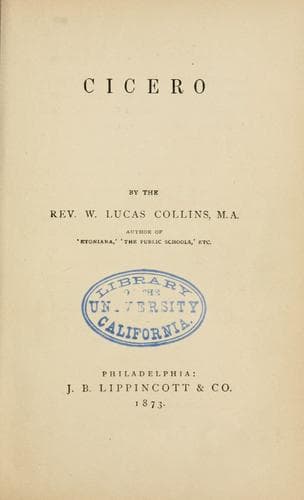
End of the Project Gutenberg EBook of Cicero, by Rev. W. Lucas Collins
Public-domain text, read in full here on John Shaqi.
Reviews
Reviews
No reviews yet
Be the first to share your thoughts on this work.
Elsewhere in the archive
Join the Discussion
Join the discussion
Sign in to leave a comment or review.
Sign InorCreate an account