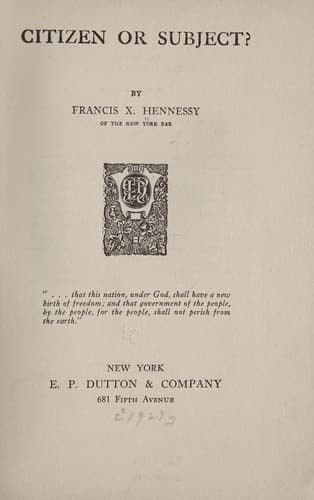
Constitutional history -- United States; United States -- Politics and government; United States. Constitution. 18th Amendment
Having their vital and accurate knowledge of the difference between
_federal_ and _national_ Articles, that only the latter kind exercises
or grants power to interfere with individual human freedom, we
recognize at once why the state legislatures are also mentioned in
the Fifth Article, although they never can make _national_ Articles.
We know it is because those “legislatures,” as the Tenth Amendment
expressly declares, retain their existing ability to make _federal_
Articles or Articles which neither exercise nor grant power to
interfere with individual freedom. And, sitting in those “conventions,”
where Hamilton also sits, we recall his remarkable prophecy, just
made to us in _The Federalist_, as we were about to enter the
“conventions” with the other Americans therein. “For my own part, I
acknowledge a thorough conviction that any amendments which may, upon
mature consideration, be thought useful, will be applicable to the
organization of the government, _not to the mass of its powers_.”
(_Fed._ No. 85.) In that absolutely accurate advance knowledge of
the complete history of constitutional amendment from 1789 to 1917,
we recognize the motive which prompted Madison _and Hamilton_,
on September 10, 1787, to add the mention of those legislative
governments to the Fifth Article mention of the _exclusive_ ability
of the people or “conventions” to make all future Articles which
_do_ relate to the “mass of its powers” to interfere with individual
freedom conferred upon the one government of America. We understand
that these legislative governments are mentioned in the Fifth Article,
which we are now reading in the “conventions” of old, because those
“legislatures” have an existing ability to make _federal_ Articles
which relate to other things than the _national_ power of government to
interfere with individual freedom.
Having thus satisfied ourselves, in those conventions, that we
ourselves, the “people” of America, _are_ mentioned in the Fifth
Article as the sole makers of any future Article which exercises or
grants power to interfere with our individual freedom, we turn with
interest to the procedure which the Article establishes as the only
_constitutional_ mode of procedure in which that exclusive ability of
our own may hereafter be evoked to exercise and be exercised.
From the language of the Article itself, we know at once that it is
simply the statement of a mode of procedure in which our own unlimited
ability or the limited ability of the state legislatures, when the
occasion seems to arise for the respective exercise of either ability,
are hereafter to be evoked by some body of men, playing the part
which the Philadelphia Convention has just played in evoking our own
exclusive ability, the ability of the “people” or “conventions.”
Public-domain text, read in full here on John Shaqi.
Reviews
Reviews
No reviews yet
Be the first to share your thoughts on this work.
Elsewhere in the archive
Join the Discussion
Join the discussion
Sign in to leave a comment or review.
Sign InorCreate an account