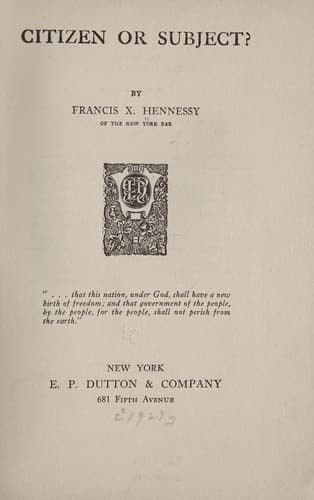
Constitutional history -- United States; United States -- Politics and government; United States. Constitution. 18th Amendment
We are not misled because the Article prescribes this one
_constitutional_ mode to evoke the existing limited ability or the
existing unlimited ability. Providing a CONSTITUTIONAL mode for
the exercise of either does not lessen one ability or increase the
other. By reason of our education, we know the difference between the
_revolutionary_ exercise of existing power and the _constitutional_
exercise of existing power. Because we have become of the “people
better acquainted with the science of government than any other
people in the world,” we know that to do something in a revolutionary
manner does not necessarily mean to do it by bloodshed or on the
battle-field. We know that to do something in a revolutionary manner
means to do it outside of any legally prescribed mode of procedure for
the exercise of existing power. We know that to do the same thing,
in a _constitutional_ mode, is to do it in some mode prescribed by
human law or constitution. And that is why we understand, as did the
men with whom we are sitting in those conventions, that Congress, in
the future, is to do exactly what the Philadelphia Convention did
_and nothing more_. Congress is to do it _constitutionally_ (where
the Philadelphia Convention did it outside of any human law and in
a _revolutionary_ manner) _because_ the Fifth Article commands that
Congress alone shall do it. Congress, when doing it, will be exercising
no power. The Philadelphia Convention exercised no power when it did
exactly the same things. And, when Congress does it, Congress will be
bound, as Philadelphia was bound, to ascertain and propose the mode
of ratification by which the proposed Article will be ratified by
ratifiers competent to make that particular kind of an Article.
As we sit in the “conventions” and keep clearly in our mind that the
“conventions” and the “state legislatures” (both of which are mentioned
in the Fifth Article) each have existing but very different abilities
to make Articles, every part of the language of the Fifth Article
confirms our knowledge that the whole Article is no “grant” of power
but is a “constitutional” mode for the exercise of existing powers.
Public-domain text, read in full here on John Shaqi.
Reviews
Reviews
No reviews yet
Be the first to share your thoughts on this work.
Elsewhere in the archive
Join the Discussion
Join the discussion
Sign in to leave a comment or review.
Sign InorCreate an account