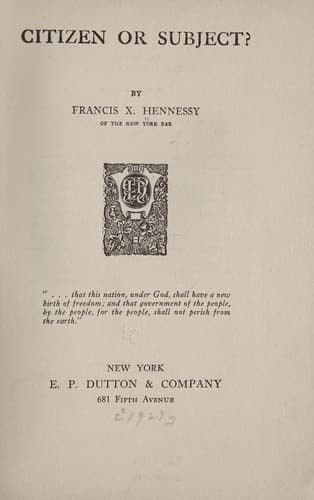
Constitutional history -- United States; United States -- Politics and government; United States. Constitution. 18th Amendment
Sitting in those old conventions, we now have read the procedural
provisions of the Fifth Article up to the point where proposals bring,
in a _constitutional_ manner, a proposed new Article to makers with
existing ability to make the particular Article which has come to them.
We now read with interest the next chronological step of the procedural
provisions, the mention of the two existing makers of Articles--the
state legislatures, makers of federal or declaratory Articles, and the
“conventions” of the American citizens, makers of any Article.
We are actually sitting in “conventions” identical with those named in
the Fifth Article. We are in the “conventions” mentioned in the Seventh
Article and named therein by exactly the same word as is used in the
Fifth Article, the word “conventions.” Both Seventh and Fifth Articles
have been worded at Philadelphia. We, assembled in the “conventions”
named in the Seventh Article, are the whole American people. In
our conventions, so assembled, we are to make both the Seventh and
the Fifth Articles, with their common use of exactly the same word
“conventions.” And so we understand, with a knowledge which nothing
can disturb, that the “conventions” of the Fifth Article mean exactly
what the “conventions” of the Seventh Article mean. Thus we know, with
knowledge which nothing can disturb, that the “conventions,” named in
both Articles, are the American people, only competent makers (in 1787
or at any future time) of _national_ Articles which interfere with or
grant power to interfere with the individual freedom of the American
citizen.
We recall vividly the proposal that came from Philadelphia eleven years
earlier or in 1776, that the Americans in each former colony constitute
a government with such powers to interfere with the human freedom of
its citizens. We recall that such governments were constituted in
what Marshall states to be the only way in which men can act safely,
effectively or wisely, when constituting government of themselves,
namely, by assembling in “conventions.”
We also recall vividly the proposal that came from the same
Philadelphia a year later or in 1777, that the states constitute
a federal government of states. And we recall that the state
legislatures, because they possessed existing ability to make _federal_
Articles, did validly make the _federal_ Articles suggested in that
proposal.
Public-domain text, read in full here on John Shaqi.
Reviews
Reviews
No reviews yet
Be the first to share your thoughts on this work.
Elsewhere in the archive
Join the Discussion
Join the discussion
Sign in to leave a comment or review.
Sign InorCreate an account