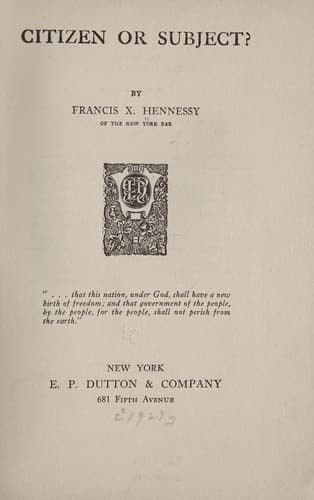
Constitutional history -- United States; United States -- Politics and government; United States. Constitution. 18th Amendment
We realize, as the Preamble of the Constitution before us expressly
declares, what is the first proposal upon which we act affirmatively,
when we say “Yes” to the whole proposal from Philadelphia. The first
effect of that “Yes” is that we, that part of the American people
in that particular state, do consent (with the Americans in eight
or more other willing states) to join the new nation or political
society of men, which is to be America, and that we consent to be,
with those other Americans, the citizens of the new nation as soon as
the Americans in eight other willing states give their similar “Yes.”
We are well aware, as we sit in one of the “conventions,” that the
Philadelphia proposal has left it open for the free Americans in each
state to become members or not of the new society as they please,
and that, therefore, the joining of that society, by the Americans
in at least nine states, will mean that the new nation is created by
unanimous action of the majority in every state whose Americans become
citizens of America.
From which we realize that the original grants of national power by
_its_ citizens to the only government of the new nation will be the
second effect of the “Yes” from the Americans in nine conventions. Thus
these original grants, the First Article grants of enumerated power to
interfere with the individual freedom of the American citizen, will be
made simultaneously by the majority of Americans in _every_ state where
Americans become citizens.
But, once these early Americans leave those first “conventions,” the
whole American people will constitute the members or citizens of the
new nation, America.
The people of these United States constitute one nation. They have a
government in which all of them are deeply interested. (Justice Miller
in the Supreme Court, Crandall v. Nevada, 6 _Wall._ 35.)
As in any other republican nation, all _national_ powers must be
granted by its members or citizens. Any future _national_ power, not
granted by the citizens themselves, will be neither just nor valid
because power of the American government to interfere with the freedom
of the American citizen will not have been granted by those to be
governed by its exercise.
Public-domain text, read in full here on John Shaqi.
Reviews
Reviews
No reviews yet
Be the first to share your thoughts on this work.
Elsewhere in the archive
Join the Discussion
Join the discussion
Sign in to leave a comment or review.
Sign InorCreate an account