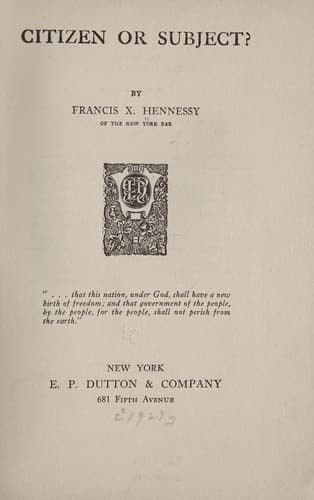
Constitutional history -- United States; United States -- Politics and government; United States. Constitution. 18th Amendment
sitting in those conventions, that a “Yes” from three fourths of the
state governments would, thereafter, be necessary and sufficient for
the making of a new proposed _federal_ or declaratory Article. And we
do _not_ understand, as the Americans in those conventions _never_
understood, that those words implied any “_grant_” of ability to the
state governments to make _any_ Articles in _our_ Constitution, much
less Articles by which governments interfere or give power to interfere
with the individual freedom of the American citizen outside the matters
enumerated in our First Article.
On the contrary, it becomes amazingly clear to us that the
“conventions” of the American citizens are mentioned in the Fifth
Article because the American citizens are the important reservee of
the Ninth and Tenth Amendments. And it becomes equally clear that the
“legislatures of the several states” are mentioned in the Fifth Article
because the “states respectively” are the _lesser_ reservees named in
the Tenth Amendment.
The Tenth Amendment tells us that no power of _any kind_ is given,
by the new Constitution, to _any_ grantee except to the new nation
and _its_ government, the American government. It tells us that some
powers, which each state had hitherto possessed, are taken from it;
that the exercise of other powers, which each state had hitherto
possessed, are now prohibited to it; and that _only_ the _other_ powers
(_which each state had hitherto possessed_) are _left_ with that state
by the command of the supreme will in America, ourselves, the citizens
of America. It tells us emphatically that no new powers of any kind
are _given_ to any state or to any collection of states or to their
governments. It tells us that the American people, in making _their_
Constitution, left each state and each state government powerless,
as they had been, alone or in combination with other governments, to
interfere with the individual rights of any human being outside that
particular state. And finally it tells us, what the Supreme Court has
expressly declared to be the most important declaration in that Tenth
Amendment, that we ourselves, the individual citizens of America, the
“people” of the Preamble and of that Tenth Amendment, retain (secure
from any valid exercise by any government or governments in the world
and only capable of exercise by ourselves in our “conventions”) every
power to interfere with the individual freedom of the American citizen
except in the matters enumerated in the First Article.
Public-domain text, read in full here on John Shaqi.
Reviews
Reviews
No reviews yet
Be the first to share your thoughts on this work.
Elsewhere in the archive
Join the Discussion
Join the discussion
Sign in to leave a comment or review.
Sign InorCreate an account