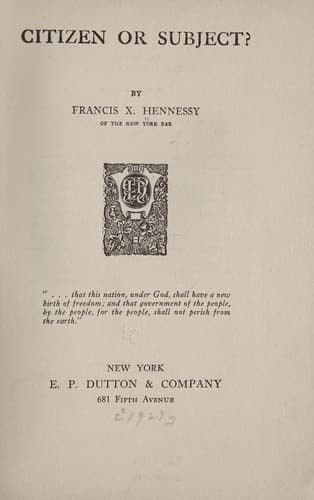
Constitutional history -- United States; United States -- Politics and government; United States. Constitution. 18th Amendment
authority as the rock on which this structure will stand. If this
principle is unfounded, the system must fall.... With how much contempt
have we seen the authority of the people treated by the legislature of
this state!” (2 _Ell. Deb._ 443, _et seq._)
But we cannot stay much longer in the Pennsylvania Convention. It
would be unwise, however, for us to depart therefrom without hearing
the accurate confirmation of our own reading and understanding of the
Fifth Article from its own “apt, precise and classic English.” Wilson
was explaining his opposition to the doctrine that a constitution is
a compact between a master government and servant people. In other
words, he was explaining the American Statute of ’76, stating the
legal principle that Americans are not “subjects.” “The citizens of
united America, I presume, do not wish to stand on that footing with
those to whom, from convenience, they please to delegate the exercise
of the general powers necessary for sustaining and preserving the
Union. They wish a principle established, by the operation of which
the legislatures may feel the direct authority of the people. The
_people_, possessing that authority, will continue to exercise it by
amending and improving their own work.” (2 _Ell. Deb._ 498.)
To us average Americans this seems like sound American law and in
strict keeping with our reading of the plain language of the Fifth
Article, as we read it with the Americans in those old conventions.
Wilson and his associates seem to know _with certainty_ that the
Fifth Article is not to change all the free individual Americans into
“subjects” of the legislative governments of which he speaks. Indeed,
he calls all those free Americans, to some of whom he was speaking,
“the citizens of America,” although the nation of America would not
exist and they would not be its citizens until they and the Americans,
_in_ eight other conventions, had said “Yes” to the Constitution they
were discussing. Therefore, when he speaks of that Constitution as
establishing a principle “by the operation of which the legislatures
may feel the direct authority of the people” or “citizens of America,”
and immediately adds that those citizens, possessing the _exclusive_
authority to exercise and vest ability to interfere with individual
freedom, “will continue to exercise it by amending and improving
their own work,” the enumerated grants of such authority in the First
Article, we realize with certainty that he and his associates know
that the Fifth Article in that Constitution does not mean that the
legislatures (who are to feel the direct authority of the people)
can thereafter exercise the authority of the citizens of America by
altering, subtracting from or adding to the First Article quantum
of delegated power to interfere with the individual freedom of the
American people.
Public-domain text, read in full here on John Shaqi.
Reviews
Reviews
No reviews yet
Be the first to share your thoughts on this work.
Elsewhere in the archive
Join the Discussion
Join the discussion
Sign in to leave a comment or review.
Sign InorCreate an account