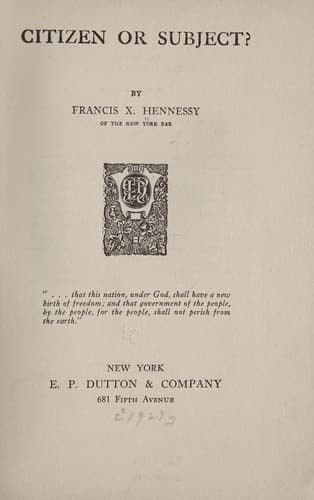
Constitutional history -- United States; United States -- Politics and government; United States. Constitution. 18th Amendment
When first we shall hear this 1917 resurrection of the Tory concept
that government is master and Americans are “subjects,” that government
is the state and we are its assets, we shall naturally be astounded and
indignant that even a few inhabitants should still retain what Madison
called “the impious doctrine” of the Old World, that people are made
for governments, not governments for the people. Quickly, however, we
shall become alarmed to find how wide-spread, among the “constitutional
thinkers” of our own generation, is the complacent acceptance of the
Tory concept and to learn that, when its application in any given
instance injures a client of one of those constitutional thinkers,
no matter how he may argue against the application in the particular
instance, he neither knows nor uses for his client the fact that the
Statute of ’76 repealed the doctrine on which Magna Charta rested,
the Tory concept that government is the state and that we are its
“subjects.”
It will be difficult for us to understand these leaders of our
generation. In addition to what we have just lived through with
the early Americans, these leaders will have before them countless
decisions of the Supreme Court, flatly contradicting the Tory concept
on which all these leaders reason. “The concessions of Magna Charta
were wrung from the King as guarantees against the oppressions and
usurpations of his prerogatives.... The omnipotence of Parliament over
the common law was absolute, even against common right and reason. The
actual and practical security for English liberty against legislative
tyranny was the power of a free public opinion represented by the
Commons.” We are going to find many of _our_ leaders with the fixed
Tory concept that there is in America a legislative government, unknown
to the generation of Americans who created all government in America,
and that this omnipotent government can do whatever it pleases, without
any constitutional restraint, with _almost_ everything in America,
including ourselves and our Constitution and our American government.
Curiously enough, we are going to be told that the one thing, in
which this omnipotent legislative government falls short of absolute
omnipotence, has nothing to do with any individual human freedom, but
is its inability to change the equal representation of every state
in our Senate. It will be quite amazing to us to hear these men, not
_proving_ this Tory concept but stating it as axiomatic American law
and on it basing their every argument and audaciously claiming that
our Supreme Court has no right even to consider whether it is so or
not. But there will be something to alarm us even more. We will find
_our_ other “constitutional thinkers,” by circumstances obliged to
challenge some particular deduction from this Tory concept, without
any knowledge of the invincible facts which challenge the concept
itself. To most of these men it will be as if the Statute of ’76 had
Public-domain text, read in full here on John Shaqi.
Reviews
Reviews
No reviews yet
Be the first to share your thoughts on this work.
Elsewhere in the archive
Join the Discussion
Join the discussion
Sign in to leave a comment or review.
Sign InorCreate an account