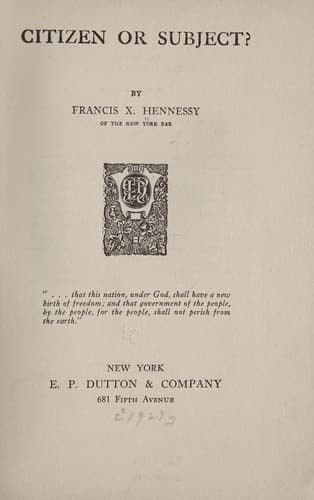
Constitutional history -- United States; United States -- Politics and government; United States. Constitution. 18th Amendment
The Sixteenth Amendment merely removed, in one respect, this _federal_
limitation upon the exercise of the national power of direct taxation
granted by the First Article. The Amendment read: “The Congress shall
have power to lay and collect taxes on incomes, from whatever source
derived, without apportionment among the several states, and without
regard to any census or enumeration.” This Amendment, being nothing but
a change in the _federal_ aspect of the Constitution, being a change
in the protection given to each state as a political entity, was an
Amendment which the state legislatures, each acting as attorney in fact
for its own respective state, were entirely competent to make.
The Seventeenth Amendment has no relation to human freedom. It merely
provided that the state governments should no longer elect the august
Senators in the American Congress, some of whom we shall meet later
herein.
This last Amendment, prior to 1917, provided that those Senators should
be thereafter elected in our states by ourselves, the American people.
Curiously enough, it is from the Senate in which they sit that came
the proposal which caused the trouble which is obliging us to educate
ourselves to find our “when” and “how” between 1907 and 1917 we became
“subjects” instead of keeping our status as citizens of America.
Early in our education (p. 26) we were informed that our public
statesmen and constitutional thinkers brought to the year 1917 the
false “knowledge” that legislatures in America, if enough combined,
had the omnipotence over individual freedom, which the early Americans
denied to the British Parliament. Their false “knowledge” was
undoubtedly caused by their failure to appreciate, if they knew or
remembered, that America is a _national_ union of men while there is
also a subordinate and _federal_ union of states. Ignoring this simple
fact, they also ignored the important fact that the Constitution is
both _national_ and _federal_ and contains Articles _of both kinds_.
Blind to both important facts, they acquired their false “knowledge”
from the fact that the “legislatures,” to whom they ascribed
omnipotence over individual freedom, had made the first seventeen
Amendments.
The fallacy of their deduction is mathematically demonstrable.
A constitutional Article which gives to government any power to
interfere with individual human freedom IS the constitution of
government of men. That is why the First Article WAS the constitution
of the government of the nation of men. And, in turn, _that_ is why
the legal necessity of having it made by the men themselves, in their
“conventions,” was “felt and acknowledged by all” Americans.
Public-domain text, read in full here on John Shaqi.
Reviews
Reviews
No reviews yet
Be the first to share your thoughts on this work.
Elsewhere in the archive
Join the Discussion
Join the discussion
Sign in to leave a comment or review.
Sign InorCreate an account