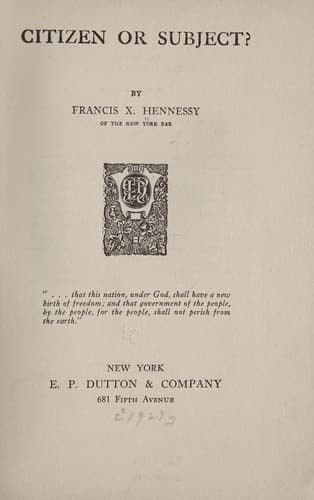
Constitutional history -- United States; United States -- Politics and government; United States. Constitution. 18th Amendment
Yet the statesmen of America, when its citizens were offering their
lives and their all, chose that December of 1917 to propose that
legislative governments, which have never been the governments of the
American citizen, should exercise one of those reserved powers of “the
people” and should give to _the_ legislative government of the American
citizens future ability to exercise that same power, although American
citizens had expressly reserved the power to themselves exclusively.
In December, 1917, as in January, 1790, the American Congress was the
only legislative government of the American people.
All powers _of a national character_ which are not delegated to the
national government by the Constitution are reserved to the _people_
of the United States. (Justice Brewer, in the Supreme Court, Kansas v.
Colorado, 206 _U. S._ 46 at p. 90.)
Outside of _that_ legislature, American citizens have _no_ legislative
government.
Its powers are limited in number, but not in degree. Within the scope
of its powers, as enumerated and defined, it is supreme and above
the states; but beyond, it has no existence. (Justice Waite, in the
Supreme Court, United States v. Cruikshank, 92 _U. S._ 542.)
In the Senate, on April 4, 1917, Senator Sheppard of Texas had
introduced a Resolution, known as Senate Joint Resolution 17. The
Resolution itself, apart from the proposed new constitutional Article
which the senator suggested that legislative governments should make,
read as follows: “_Resolved by the Senate and House of Representatives
of the United States of America in Congress assembled (two thirds of
each House concurring therein), That_ the following amendment to the
Constitution be, and hereby is, proposed to the States, to become valid
as a part of the Constitution when ratified by the legislatures of the
several States as provided by the Constitution:”
The proposed new national Article, which this 1917 Resolution suggested
should be made by legislative _governments_, originally and in April,
1917, read as follows:
* * * * *
“Article--.
“SECTION 1. The manufacture, sale, or transportation of intoxicating
liquors within, the importation thereof into, and the exportation
thereof from the United States and all territory subject to the
jurisdiction thereof for beverage purposes are hereby prohibited,
“SECTION 2. The Congress shall have power to enforce this article by
appropriate legislation, and nothing in this article shall deprive the
several States of their power to enact and enforce laws prohibiting the
traffic in intoxicating liquors.”
By reason of _our_ education in the actual constitution of our only
American government and our respective state governments, we grasp
immediately the startling nature of the suggestion that the state
governments make that Section 1 and that Section 2. We first dwell with
amazement upon the proposed Section 1 and its proposed makers.
Public-domain text, read in full here on John Shaqi.
Reviews
Reviews
No reviews yet
Be the first to share your thoughts on this work.
Elsewhere in the archive
Join the Discussion
Join the discussion
Sign in to leave a comment or review.
Sign InorCreate an account