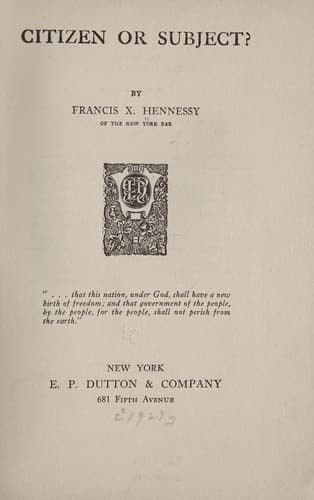
Constitutional history -- United States; United States -- Politics and government; United States. Constitution. 18th Amendment
When our present Constitution was before the people of America, waiting
their approval or rejection, Madison and Hamilton published their
series of essays, now known as _The Federalist_. It is not our intent
to dwell upon the knowledge of American basic law shown by these two
men. Elsewhere our Supreme Court has paid its deserved tribute to _The
Federalist_ as an authority of the greatest weight in the meaning of
our Constitution. At this moment, we desire to mention one remarkable
quality which makes those essays unique among arguments written in the
heat of a great political controversy. They were written to urge that
human beings create a great nation and grant some enumerated powers
to interfere with their own freedom. They were written when other
great leaders were opposing that project with the utmost ability and
eloquence. These opponents, as is the custom with men in any heated
controversy, denounced the project and its advocates. The abuse of both
project and advocates has probably never been exceeded in America. Yet
it is one remarkable quality of the arguments of Madison and Hamilton,
in _The Federalist_, that they themselves never leave the realm of
reason and fact and law, or descend to irrelevant abuse of those who
differ in opinion with them.
We, who have lived through the last five years in America, can
truthfully say that the advocates of the new constitution of
government, the Eighteenth Amendment, have made their essays and
speeches and arguments notable for the same quality, by its utter
absence.
Because fact would interfere with the making of their new Constitution,
they have changed fact. Because law meant that government could not
constitute their government of the people, they have stated law which
has never been law in America since 1776. Because reason would prevent
the achievement of their purpose, they have appealed to irrelevant
abuse of those who dared to differ in opinion with them.
In view of these known facts, we average Americans shall not be
surprised when we read the record of the Senate on its own proposal
that government should exercise a power not delegated to interfere with
individual freedom. Fresh from the reading of the record in the House,
we shall not be surprised to find that the Senate also ignored the most
important factors in the Tenth Amendment and the Fifth Article, “the
people” in the one, and the mention of the people’s exclusive ability
to make _national_ Articles in the other.
Public-domain text, read in full here on John Shaqi.
Reviews
Reviews
No reviews yet
Be the first to share your thoughts on this work.
Elsewhere in the archive
Join the Discussion
Join the discussion
Sign in to leave a comment or review.
Sign InorCreate an account