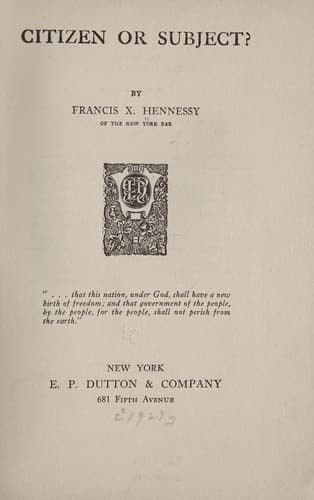
Constitutional history -- United States; United States -- Politics and government; United States. Constitution. 18th Amendment
That is why anything which _these_ “legislatures” do, when it comes
in conflict with a valid action of _our_ legislature, the Congress,
must always yield. We have the supreme will in America, and when
_our_ agent, the Congress, speaks with authority from us, it speaks
for us, while the inferior agents of other lesser wills never speak
for us. That clear distinction does not detract from the ability of
those legislatures to make _federal_ Articles in our Constitution.
They do not get that ability from us, the citizens of America. They
had that ability from those respective inferior wills, when we made
our Constitution. By its exercise, they had made the federation of
states and the _federal_ Articles of its government. When we made our
national Constitution, we continued that federation and the ability of
its component members to make its federal Articles and put them in our
Constitution, which is both our national Constitution and their federal
Constitution. The ability to make those _federal_ Articles is one of
the powers reserved to those inferior wills by the reservation of the
Tenth Amendment which reads “to the states respectively”; and it is not
an ability to make Articles which is granted in the Fifth Article. No
ability to make Articles is _granted_ in that Fifth Article.
Inasmuch, however, as the writer of the brief in 1920 has known that
“legislatures” do not ever become “the people,” it is quite probable
that his reference did not intend to suggest that the legislatures of
which he spoke and who are the agents respectively of other citizens,
were the agents, for any purpose, of the citizens of America. With
his recognition that legislatures never are the people and with the
other quoted extracts of those briefs of 1920 before us, echoing the
knowledge we have acquired, we feel at least that in the court of 1920,
from the debate of men who know, we will learn whether and “when” and
“how,” we, between 1907 and 1917, became subjects instead of the free
men and citizens which we clearly were up to 1907.
At least such was the thought of one American citizen, when he read
this quotation, in one of the briefs of 1920, “that the people do
not become a legislature.... As well confound the creator and the
creature--the principal and the agent through which he acts.” It was
almost incredible to this particular American citizen that he found
this statement and the statement that--“The Constitution is not a
compact between states. It proceeds directly from the people.”--both
in the briefs of the foremost champion of the new Amendment. And it
seemed equally incredible to him to find the quotation about the
Statute of ’76 being “one great muniment of our liberty which can never
be amended, revoked or withdrawn” in the brief of the counsel for the
political organization which dictated the new state government command
to the citizens of America.
Public-domain text, read in full here on John Shaqi.
Reviews
Reviews
No reviews yet
Be the first to share your thoughts on this work.
Elsewhere in the archive
Join the Discussion
Join the discussion
Sign in to leave a comment or review.
Sign InorCreate an account