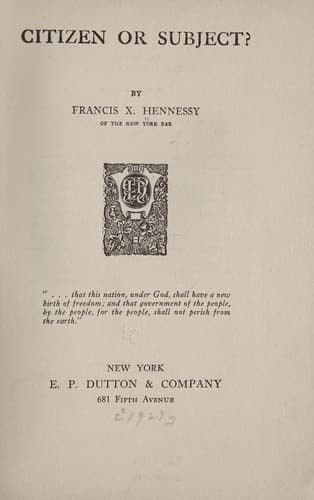
Constitutional history -- United States; United States -- Politics and government; United States. Constitution. 18th Amendment
And so, coming from the only “conventions” of that kind yet held,
we grasp at once the absolute accuracy of the statement in the
fourth conclusion of the Court in 1920. The _mention_ of the same
“conventions” in the Fifth Article, a mention made by the “conventions”
of the Seventh Article, is the sound basis for our knowledge that, as
the Tenth Amendment expressly declares, those “conventions” of the
Seventh expressly _reserved_ to themselves (the same “conventions”
named in the Fifth, “the people” of America in the Tenth Amendment)
their own exclusive ability to make _national_ Articles, like the
First Article and the Eighteenth Amendment. For which reason, we
know the truth of the Court statement in its fourth conclusion, that
the power to make the Eighteenth Amendment “is within the power
to amend _reserved_ by Article V.” The _exclusive_ ability of the
“conventions” of 1787 and 1788--to make the Article which is that new
Amendment--is something known to all who were in those “conventions.”
That the ability--to make Articles like the First Article and the new
Amendment--_remained_ exclusively in such “conventions” of the American
citizens, because such Articles are _national_ and either directly
interfere with or are the basis for direct interference with individual
freedom of the American citizen, was also known to every one in those
“conventions.” That is why the Americans in those early “conventions”
insisted that the Tenth Amendment expressly declare that such exclusive
ability _was_ reserved to them, “the people” of that Amendment, and why
the same “conventions” mentioned themselves, the “conventions,” in the
Fifth Article and provided therein the CONSTITUTIONAL mode of procedure
in which that exclusive ability could thereafter be exercised by those
who had it, the “conventions” of the American citizens.
Public-domain text, read in full here on John Shaqi.
Reviews
Reviews
No reviews yet
Be the first to share your thoughts on this work.
Elsewhere in the archive
Join the Discussion
Join the discussion
Sign in to leave a comment or review.
Sign InorCreate an account