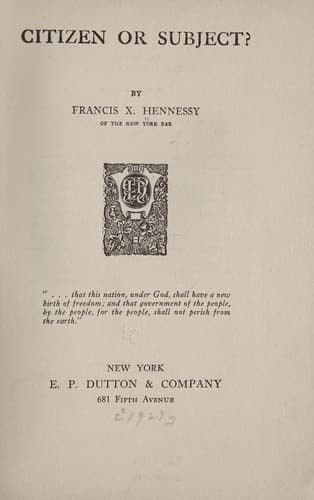
Constitutional history -- United States; United States -- Politics and government; United States. Constitution. 18th Amendment
We have examined the four conclusions of the Supreme Court which deal
with any argument _presented_ against the existence of the Eighteenth
Amendment. Those conclusions negative every such argument that was
presented. But, because every brief assumed and asserted that the
amending power “_reserved_” in the Fifth Article had been “_granted_”
therein, the four conclusions make clear that the Court has yet to hear
and pass upon the challenge which reads the Eighteenth Amendment out of
our Constitution. When that challenge is presented by American lawyers,
who know what American basic law is and how American citizens are
constitutionally protected against usurpation of power by governments
in America, there can be no doubt of the decision of the Supreme Court.
In _that_ decision, there will be no conclusion denying the most
important legal fact in America, namely, that _governments_ cannot
exercise ungranted power or create new government power to interfere
with the individual freedom of the American citizen. In _that_
decision, there will be again the simple statement of the undoubted
fact that the ability to make the Eighteenth Amendment “is within the
power to amend _reserved_ by Article V.” But, in _that_ decision, there
will be _added_ the plain statement of the Tenth Amendment that such
ability was _not reserved_ to the state legislatures who never had it,
but _was_ reserved to the “conventions,” who always had it and still
have it. And, comparing that future decision (which is certain to come
from the Supreme Court) with the decision, which merely negatived the
four unsound challenges which _were_ made to the Eighteenth Amendment,
we know that the first five conclusions of the latter decision--all
the conclusions that have aught to do with the existence and validity
of the Eighteenth Amendment--merely hold that the existence of the new
Amendment is not affected by any of these challenges which _were_ made.
With exceeding wisdom in our humble opinion, the Court carefully
refrains from passing upon or determining any question except the
exact challenges which _were_ presented. That is why no opinion was
written. When any general statement (seeming to bear upon questions
not presented or submitted) might come back to perplex and annoy the
Court in future litigation where protected liberty of the American
citizen was the challenge to the government-made new Article, common
sense and sound reason and the experience of generations dictated that
no general statement should be made. And, as there was but one way to
avoid a single general statement, no opinion was written. This method
of deciding those particular litigations, with their four unsound
challenges, would leave the decision itself without even an apparent
influence upon a litigation in which some _real_ challenge might be
presented.
Public-domain text, read in full here on John Shaqi.
Reviews
Reviews
No reviews yet
Be the first to share your thoughts on this work.
Elsewhere in the archive
Join the Discussion
Join the discussion
Sign in to leave a comment or review.
Sign InorCreate an account