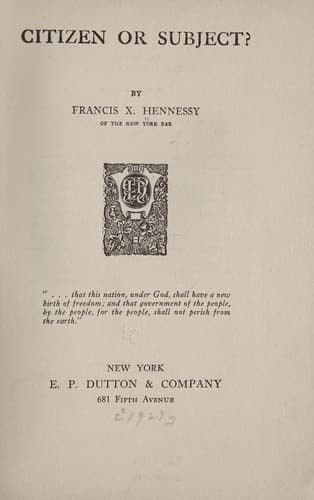
Constitutional history -- United States; United States -- Politics and government; United States. Constitution. 18th Amendment
When the common proposition of all those lawyers, that the Fifth
Article “grants” power to those two grantees, _is_ stated in this frank
way, its patent absurdity is manifest. Every one of those lawyers knows
that a grantor never can or does grant to himself either _all_ or _part
of_ what he already has. Moreover, all those lawyers ought to know that
the Tenth Amendment expressly declares that the entire Constitution,
in which is the Fifth Article, grants no power of any kind except to
the American government at Washington. Alone and unaided, this simple
declaration makes it impossible that the Fifth Article grants any power
to the state governments. Thus, even without the certain knowledge we
bring from the conventions of 1788, the state governments disappear
from the scene as attorneys in fact for the citizens of America in any
matter. Each of those state governments is left with no power it did
not have before the Fifth Article was made. Not one of them even keeps
all of the power which it had before 1788. The citizens of America,
the “conventions” in which they assembled, commanded otherwise. “When
the American people created a national legislature, with certain
enumerated powers, it was neither necessary nor proper to define the
powers retained by the States. These powers proceed, _not from the
people of America_, [the “conventions” named in the Seventh _and the
Fifth_ Articles] _but from the people of the several states_; and
remain, after the adoption of the Constitution, what they were before,
except so far as they may be abridged by that instrument.” So spoke
Marshall from the Supreme Court Bench, in 1819, after he had come from
one of those “conventions” in which he himself had stated: “It could
not be said that the states derived any powers from that system, [the
new Constitution then before the convention in Virginia] but retained
them, though not acknowledged in any part of it.” (3 _Ell. Deb._ 421.)
Yet every brief of those fifty-seven lawyers bases its every argument
on the sheer assumption, asserted by all, that the Fifth Article is a
“grant” to the state legislatures which makes them attorneys in fact
for the citizens of America. No brief can offer and no brief does
offer the slightest proof in support of the assumption. But no brief
_asks_ for proof of the assumption or challenges the assumption. On the
contrary, every brief makes the assumption and asserts it and on it
rests every argument.
Because of this monumental error, every brief _for_ the Amendment
insists that the state legislatures, as attorneys in fact for the
citizens of America with _every_ power of the citizens of America,
validly made the Eighteenth Amendment.
Public-domain text, read in full here on John Shaqi.
Reviews
Reviews
No reviews yet
Be the first to share your thoughts on this work.
Elsewhere in the archive
Join the Discussion
Join the discussion
Sign in to leave a comment or review.
Sign InorCreate an account