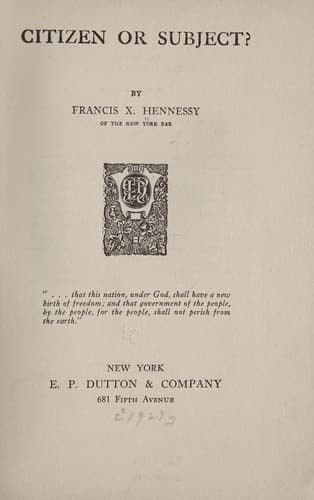
Constitutional history -- United States; United States -- Politics and government; United States. Constitution. 18th Amendment
Root was their leader. A distinguished public leader and considered by
many to be the leader of the American Bar, there was special reason why
_he_ should have known the ability of _government_ to _make_ national
Articles in a Constitution, _only_ when men are “subjects,” and the
inability of _governments_ to _make_ such Articles, when men are
“citizens.”
If his brief, or the brief of any challenger, had urged this real and
invincible challenge, we would have found the mention of that challenge
in the decision _and it would not have been a refutation of that
challenge_. That we may confirm our knowledge that the brief of Root,
_like the brief of every challenger_, did not make this challenge, the
challenge that the Fifth Article is _no “grant”_ but a _mention_ of
two existing abilities and a mode of CONSTITUTIONAL procedure for the
respective exercise of each, let us read the brief’s own statements of
the three challenges it does make. “The plaintiff contends that this
attempted amendment to the Constitution of the United States is invalid
(1) because it constitutes mere legislation, and is, therefore, not
authorized by Article V of the Constitution, (2) because it impairs
the reserved police or governmental powers of the several States and
their right to local self-government, and (3) because it has not been
ratified by three fourths of the several States since it has not been
submitted to the electorate of the States in which the initiative, or
the referendum, or both, prevail (assignment of errors Nos. 1-5). These
questions are discussed in points II, III, and IV, respectively. In
point I the prior amendments to the Constitution are considered with
reference to these contentions, and in point V the justiciability of
the contentions is maintained.”
Its first challenge is itself the admission that all CONSTITUTIONAL
ability to change our Constitution is ability “_granted_” in the Fifth
Article. Moreover, it is the flat denial of any CONSTITUTIONAL mode
of procedure in which the citizens of America, by a “Yes” from three
fourths of their assembled “conventions,” can enact the legislation
which is Section One of the supposed Eighteenth Amendment.
Its second challenge is wholly on behalf of the political entities,
which are the states. It not only makes no claim for the rights of
American citizens, but it denies any CONSTITUTIONAL ability in the
American citizens to interfere, by changing the American Constitution,
with what _the American citizens_ reserved to each state and _its
citizens_.
The third challenge again fails to assert any claim on behalf of the
rights of the _American_ citizens. It is the challenge negatived by the
third conclusion of the Supreme Court. It is the challenge that the
citizens _of the State_, in some of the states, are part of the state
legislature.
Public-domain text, read in full here on John Shaqi.
Reviews
Reviews
No reviews yet
Be the first to share your thoughts on this work.
Elsewhere in the archive
Join the Discussion
Join the discussion
Sign in to leave a comment or review.
Sign InorCreate an account