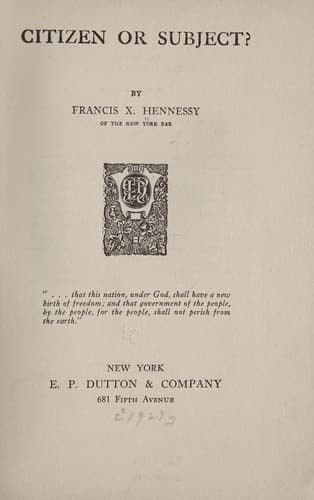
Constitutional history -- United States; United States -- Politics and government; United States. Constitution. 18th Amendment
It will serve no useful purpose for us to dwell further upon the briefs
against validity. They all show the universal conviction that the Fifth
Article _is_ a “grant” and makes the state legislatures attorneys in
fact for ourselves, the citizens of America, who elect not a single
member in the state legislatures. Naturally, as this fundamental
error is the invincible conviction of all counsel against validity
before any brief is written, none of those briefs mentions such simple
facts as the fact decided by the Supreme Court in Barron v. City of
Baltimore, 7 _Pet._ 243. That decision, by John Marshall, decisively
settled the legal fact that the Fifth Article grants no power to the
state legislatures to make the Eighteenth Amendment. _And_, as it also
decisively settled that the Fifth Article _does not give_ the state
legislatures _any_ power whatever, it destroys the absurd concept
that the Fifth Article makes the state legislatures attorneys in
fact for those who made the Fifth Article, the citizens of America,
the “conventions” of the Fifth Article and the Seventh Article. But
lawyers, who start to write briefs with the certain (although false)
“knowledge” that the Fifth Article _does_ make the state legislatures
attorneys in fact for the citizens of America, neither know the meaning
of that decision nor state the decision and its meaning and its effect
upon the Eighteenth Amendment in the briefs which they write. The
decision is very clear. We have met it earlier in our education herein.
It will bear repetition right now, when we find fifty-seven lawyers all
“knowing” that the Fifth Article (despite the declaration of the Tenth
Amendment) does give power to the state governments and, by giving it,
makes these governments attorneys in fact for the citizens of America.
Barron claimed that a state statute was void because it came in
conflict with the restriction imposed by the Article which is the Fifth
Amendment to the American Constitution. If the restriction applied to
the state legislatures and their powers, the statute was clearly void.
Therefore, as Marshall pointed out, the Court had but one question
to solve, whether the American Constitution (in which is the Fifth
Article) granted _any_ power to the state governments. If it did, then
general restrictions in that Constitution, as they clearly applied
to all powers _granted_ in that Constitution, applied to the state
governments. On the contrary, if the Constitution granted _no_ power to
the state governments, general restrictions in the Constitution would
not apply to the state governments. For which reason, the decision of
the case itself was to depend on one thing alone, whether there _was_
any power granted in the entire Constitution to the state governments.
If there was not, the decision would be against Barron.
Public-domain text, read in full here on John Shaqi.
Reviews
Reviews
No reviews yet
Be the first to share your thoughts on this work.
Elsewhere in the archive
Join the Discussion
Join the discussion
Sign in to leave a comment or review.
Sign InorCreate an account